

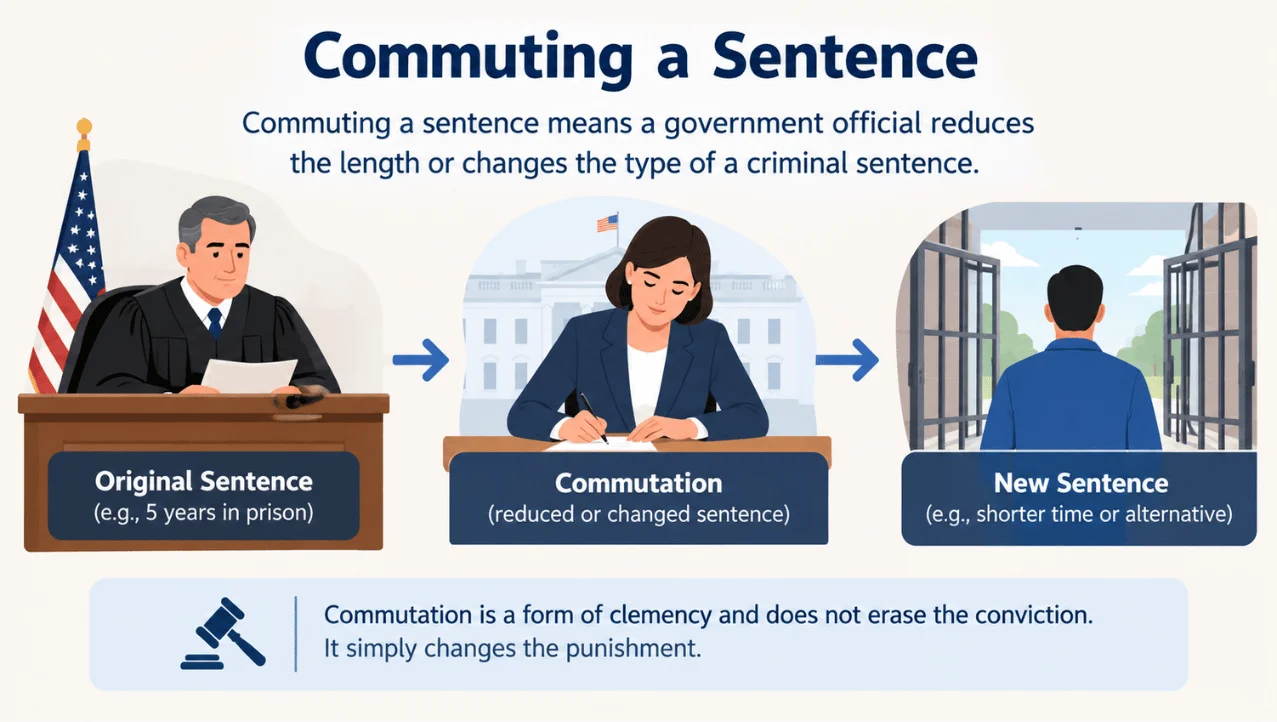
When a president, governor, or clemency board reduces a criminal punishment, news reports often describe the action as commuting a sentence. In U.S. law, commutation changes the punishment without erasing the underlying conviction or declaring the person innocent. That distinction matters because a commuted sentence can affect prison time while leaving a criminal record and other legal consequences in place. This guide explains how commutation works in federal and state cases, how it differs from a pardon or parole, and what someone seeking clemency should know.
Key Takeaways
- Commuting a sentence means replacing an existing criminal punishment with a less severe one.
- The U.S. President can commute sentences for federal offenses, while state clemency authority depends on each state’s constitution and laws.
- A commutation does not erase the conviction, establish innocence, or automatically restore civil rights.
- A sentence can be shortened without resulting in immediate release, depending on the terms of the clemency decision.
- Federal commutation applications are handled through the U.S. Department of Justice Office of the Pardon Attorney, although the President makes the ultimate clemency decision.
What Does Commuting a Sentence Mean?
Commuting a sentence means reducing or replacing a criminal punishment with a less severe punishment without overturning the conviction. A prison term may be shortened, a sentence may be reduced to time served, or another penalty may be lessened. The person generally remains convicted of the underlying offense.
The Legal Information Institute at Cornell Law School describes commuting a sentence as substituting a judicially imposed sentence with a lesser sentence. For example, a 10-year prison term could theoretically be reduced to five years, while a death sentence could be changed to life imprisonment. The conviction itself continues to exist even though the punishment has changed.
| Question | What a commutation generally does |
|---|---|
| Reduces prison time? | Yes, it can |
| Can reduce a sentence to time served? | Yes |
| Can change one punishment to a lesser one? | Yes |
| Erases the conviction? | No |
| Declares the person innocent? | No |
| Automatically expunges the record? | No |
| Automatically restores civil rights? | No |
| Always causes immediate release? | No |
Who Has the Power to Commute a Sentence in the United States?
For federal crimes, the President’s clemency authority comes from Article II, Section 2 of the U.S. Constitution, which grants power to issue reprieves and pardons for offenses against the United States, except in impeachment cases. Courts have long recognized that this constitutional clemency power includes commutations, allowing the President to substitute a less severe punishment for the sentence imposed by a federal court. The President cannot use this federal authority to commute a sentence imposed for an ordinary state-law conviction.
State cases work differently because each state establishes its own clemency system. Depending on the jurisdiction, authority may rest with the governor, a pardon or parole board, or a process in which multiple officials share responsibility. The DOJ therefore advises people seeking clemency for state convictions to contact the appropriate authorities in the state where the conviction occurred rather than applying for presidential clemency.
How Does Commuting a Sentence Work?
Commutation is an exercise of executive clemency rather than a court ruling that the original conviction was legally incorrect. The executive authority decides whether to reduce an existing punishment after considering the petition and whatever information the applicable clemency system requires. Because the rules for federal and state cases differ, identifying which government imposed the sentence is one of the first practical steps.
Confirm Whether the Sentence Is Federal or State
A federal conviction falls within presidential clemency authority, while an ordinary state conviction does not. The DOJ specifically states that the President’s power applies to federal offenses and certain District of Columbia offenses within the relevant federal clemency framework. A person with a state conviction should instead identify the governor, pardon board, parole board, or other clemency authority designated by that state.
Use the Federal Commutation Application for a Federal Sentence
The Office of the Pardon Attorney currently directs people who have been sentenced by a federal court to its application for commutation of sentence. Applicants should obtain that form directly from the DOJ rather than relying on unofficial online forms or services. The DOJ’s clemency application page states that a federal petitioner must submit the official Petition for Commutation of Sentence to the Office of the Pardon Attorney, and it provides the current form and filing instructions.
Explain Why Clemency Is Appropriate
Federal guidance describes commutation as an extraordinary remedy and identifies several circumstances that have traditionally been relevant to its consideration. These include undue severity or disparity in a sentence, serious illness or advanced age, significant assistance to the government, demonstrated rehabilitation while in custody, and important circumstances that were not anticipated at sentencing. Time already served and the availability of other legal remedies may also be considered when officials review a petition.
Provide Complete and Accurate Information
A commutation petition should accurately explain the conviction, sentence, requested relief, and circumstances supporting clemency. The DOJ’s instructions allow applicants to provide additional documents or pages that clarify their answers, while incomplete information can interfere with processing. Federal clemency is primarily a written process rather than a conventional courtroom hearing.
What Factors May Support a Federal Commutation?
There is no simple checklist that guarantees a successful presidential commutation. The Justice Manual identifies factors traditionally considered in appropriate cases, including unusually severe or disparate punishment, critical illness, advanced age, valuable government cooperation, rehabilitation during incarceration, and unforeseen exigent circumstances. These considerations help officials assess whether extraordinary clemency may be justified, but the existence of one or more favorable factors does not create an entitlement to relief.
The availability of another remedy can matter as well. Federal guidance notes that officials consider how much of the sentence has already been served and whether another judicial or administrative procedure could address the problem. A commutation petition therefore should not be treated as an ordinary substitute for an appeal, sentencing motion, or other available legal proceeding.
Commutation vs. Pardon, Parole, Appeal, and Expungement

Several legal remedies can affect a sentence or criminal record, but they operate in fundamentally different ways. Confusion is particularly common between commutation and pardon because both fall under the broader concept of executive clemency. Understanding which remedy changes the punishment, the conviction, or the record helps prevent unrealistic expectations, and WebDorBit’s Law section covers several of these remedies in more detail.
| Remedy | Main purpose | Does it erase the conviction? | Who generally acts? |
|---|---|---|---|
| Commutation | Reduces or replaces punishment | No | President or applicable state clemency authority |
| Pardon | Executive forgiveness and relief from certain consequences | No automatic expungement | President or applicable state authority |
| Parole | Conditional release under applicable correctional rules | No | Parole authority where available |
| Appeal | Challenges a conviction or ruling through the courts | Potentially, if successful | Appellate court |
| Expungement/record clearing | Limits or removes a record under applicable law | Depends on the jurisdiction and remedy | Usually a court or statutory process |
The DOJ makes an especially important point about pardons: even a presidential pardon does not automatically expunge or erase a federal conviction from the historical record. A federal commutation is more limited because it reduces a sentence without implying innocence or removing the civil disabilities resulting from the conviction. For that reason, a headline announcing clemency does not by itself tell readers whether the punishment, legal consequences, or criminal record changed.
Does a Commuted Sentence Mean Immediate Release?
A commutation can result in release, but it does not necessarily do so. If a 20-year sentence is reduced to 12 years and the person has served only eight, the individual may still have prison time remaining under the new sentence. By contrast, a commutation to “time served” can end the remaining custodial portion of a sentence when its terms take effect.
Another possibility is substituting one form of punishment for a less severe form rather than simply changing a release date. Constitutional authorities recognize commutation as the substitution of a lesser punishment for a greater one, including reducing imprisonment or changing the nature of the sentence. The practical result therefore depends on the precise wording of the clemency grant.
What Happens to the Conviction After a Sentence Is Commuted?
The underlying conviction generally remains in place after a federal sentence is commuted. According to the Office of the Pardon Attorney, federal commutation does not change the fact of conviction, imply that the person is innocent, or remove civil disabilities arising from the conviction. Someone should therefore not assume that release following commutation means the criminal record has disappeared.
This distinction can matter when a person later encounters employment, professional licensing, immigration, or other legal issues connected with the conviction. The DOJ specifically states that a commutation does not change a person’s immigration status and will not by itself prevent removal or deportation from the United States. State-law consequences can vary, so people dealing with rights restoration or record-clearing questions should check the law governing their particular conviction and residence.
Can a Commutation Include Conditions?
Yes, a clemency grant can sometimes include conditions rather than simply replacing one sentence with an unconditional shorter term. Federal Justice Department guidance recognizes that commutation may be granted subject to conditions resembling those associated with parole or supervised release. Anyone receiving conditional clemency should therefore read the actual clemency warrant or order carefully rather than assuming that all remaining obligations have ended.
A Simple Example of Commuting a Sentence
Imagine that a person receives a federal prison sentence of 20 years and later receives presidential clemency reducing the sentence to 12 years. The original 20-year punishment no longer determines how long the person must serve, but the underlying conviction has not been erased merely because the term was shortened. If that person had already served 12 years when the commutation took effect, the practical consequences could be very different from those of someone who had served only six.
A more dramatic form of commutation can replace a death sentence with life imprisonment. U.S. constitutional law has long recognized the executive power to substitute a less severe punishment in this manner, and the Supreme Court addressed such a commutation in Biddle v. Perovich. The example shows why “commuted” should not automatically be interpreted as “freed” or “pardoned.”
Do You Need a Lawyer to Apply for Commutation?
A lawyer is not required to submit a federal pardon or commutation application. The Office of the Pardon Attorney states that the clemency process is intended to be accessible to eligible applicants with or without legal representation, and it notes that many applicants proceed without attorneys. Legal assistance may still be useful when the procedural history is complicated, another court remedy is pending, or the applicant needs individualized advice about the consequences of a conviction.
If the practical question is how attorneys structure fees and services, WebDorBit’s contract lawyer cost guide provides a broader explanation of common fee arrangements, although criminal-clemency representation can involve different work and pricing. Anyone facing an active criminal case, appeal deadline, immigration issue, or release question should consider obtaining advice from an attorney licensed in the appropriate jurisdiction.
Frequently Asked Questions
Does Commuting a Sentence Erase a Criminal Conviction?
No, a federal commutation does not erase the conviction that produced the sentence. It changes some or all of the punishment specified in the clemency grant while leaving the fact of conviction intact. Expungement or other record-clearing remedies are separate legal processes and depend heavily on the jurisdiction.
Can the President Commute a State Prison Sentence?
The President cannot use Article II clemency authority to commute an ordinary state-law conviction. Presidential clemency applies to offenses against the United States and certain qualifying District of Columbia matters described by the DOJ. A person seeking relief from a state conviction must use the clemency system established by the state involved.
Is Commuting a Sentence the Same as a Pardon?
No, commutation and pardon are separate forms of executive clemency. A commutation focuses on reducing an existing sentence, while a pardon is an expression of executive forgiveness that can relieve certain legal disabilities but still does not automatically expunge the historical conviction. The difference is important whenever a person is concerned about civil rights, employment, licensing, immigration, or criminal-record consequences.
Does Commutation Always Mean Someone Gets Out of Prison?
No, the new sentence may still require additional incarceration. Someone serving 20 years could have the sentence reduced to 15 years and remain imprisoned until the reduced term is completed. Immediate release is more likely when the clemency order reduces the custodial sentence to time already served.
Can a Commutation Application Be Rejected?
Yes, submitting a clemency petition does not guarantee that relief will be granted. Federal commutation is considered an extraordinary form of relief, and the ultimate presidential clemency power is discretionary rather than an ordinary judicial remedy. Applicants should therefore present accurate information and avoid treating commutation as a guaranteed alternative to appeals or other available procedures.
Can Commuting a Sentence Reduce a Fine or Restitution?
Federal clemency may include remission of certain unpaid financial penalties imposed as part of a criminal sentence. The Office of the Pardon Attorney states that a commutation may include release from financial obligations such as a fine or restitution, depending on the clemency granted. Remission applies only to the portion that has not already been paid.
The Bottom Line
Commuting a sentence reduces criminal punishment without automatically erasing the underlying conviction. For federal offenses, the President holds this clemency power, while state cases follow the clemency structure established by the relevant state. Anyone considering an application should first identify the correct jurisdiction, review the official requirements, and distinguish clemency from appeals, pardons, parole, and record-clearing remedies.