

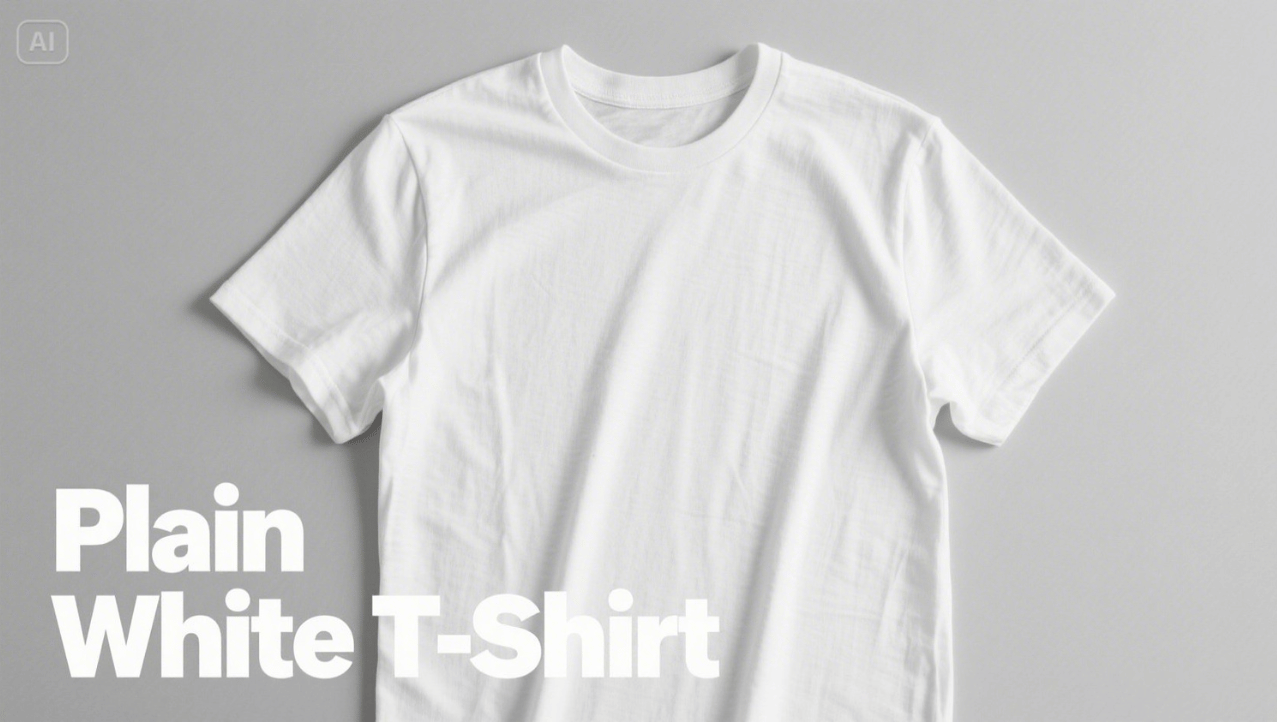
A good plain white T-shirt comes down to five measurable things: fabric weight (aim for 5–6.5 oz per square yard, roughly 180–220 gsm), yarn type (combed ring-spun cotton in a 30 or 40 singles count, not carded open-end), construction (side-seamed, not tubular), fit through the shoulder, and a finish with no stain-resistant chemistry on it. Get those right and a $30 tee will outlast a $110 one. Get them wrong and you own a translucent, twisted, yellow-armpitted shirt within six months.
The white tee is the most bought and least considered garment in the closet, and the economics around it have moved more in the last eighteen months than in the previous decade. Raw cotton is historically cheap — it traded at $0.81 a pound on 14 September 2026, near the middle of a 52-week range of $0.61 to $0.92 and far below its 2022 peak — yet the finished shirt costs more, for reasons that have nothing to do with the fiber. This guide covers the specifications that separate a good tee from a bad one, what each price tier buys you in 2026, why chemical-finish rules now affect what you should look for on a label, the laundry science that keeps white white for years, and enough of the garment’s genuinely interesting history to explain why it carries the cultural weight it does.
Quick reference: what to look for
| Specification | What to want | Why |
| Fabric weight | 5–6.5 oz/yd² (180–220 gsm) | Under 4.5 oz is see-through; over 7 oz is stiff and hot |
| Yarn | Combed ring-spun cotton | Smoother, stronger and less pill-prone than carded open-end |
| Yarn count | 30 or 40 singles (written 30/1, 40/1) | Higher number means finer yarn and a smoother hand; 18/1 is coarse promotional fabric |
| Fiber | 100% cotton, or cotton with 5–10% elastane | Pure cotton breathes; a little elastane helps a slim fit recover |
| Construction | Side seams, not tubular | Tubular bodies twist in the wash and never hang straight again |
| Collar | Ribbed 1×1 with a taped or reinforced neckline | The collar is the first thing to fail on a cheap tee |
| Shoulder seam | Sits at the edge of your shoulder bone | The single fit detail that determines whether it looks intentional |
| Pre-shrunk | Yes, or buy a size up | Untreated cotton shrinks 3–5% on first hot wash |
| Finish | No “wrinkle-free”, “stain-release” or “easy-care” claim | Those finishes are the ones most likely to carry fluorinated chemistry, now restricted in several states |
Fabric weight, explained properly
Weight is listed either in ounces per square yard or grams per square meter, and it is the most useful number on the label. It tells you about opacity, drape, durability and heat all at once. To convert between the two, multiply ounces per square yard by 33.9 to get gsm, or divide gsm by 33.9 to go the other way. A listing that gives one and not the other is not hiding anything; a listing that gives neither usually is.
- Lightweight, under 4.5 oz (150 gsm). Airy and drapey, common in fashion-brand tees and summer basics. In white, it is usually noticeably see-through, and it wears through at the shoulders fastest.
- Midweight, 5–6 oz (170–200 gsm). The correct default. Opaque enough to wear without an undershirt, soft enough to be comfortable, sturdy enough for a few years of weekly wear.
- Heavyweight, 6.5–8 oz (220–270 gsm). The boxy heavyweight look popular in streetwear. It holds its shape, never clings, and is completely opaque — but it is warm, takes a long time to dry, and reads as casual in every context.
- Very heavy, above 8 oz (270 gsm). A small but growing category, sometimes marketed at 9 or 10 oz. It behaves more like a light sweatshirt than a T-shirt, and in white it can look bulky rather than crisp.
Opacity is the specific reason weight matters more in white than in any other color. If a listing does not state a weight, assume it is light. Brands that use good fabric put the number in the description.
Yarn and knit: the words on the label that matter
Carded open-end is the cheapest yarn. Fibers are short and loosely bound, which is why a $6 promotional tee feels slightly rough and starts pilling after a handful of washes. Ring-spun twists the fibers more tightly for a smoother, stronger yarn. Combed ring-spun adds a step that removes the shortest fibers before spinning, and it is the meaningful quality line: combed ring-spun cotton pills less, holds color better and feels dramatically softer.
The number almost nobody explains is the singles count, written as 18/1, 30/1 or 40/1 and sometimes just as “30 singles”. It describes how fine the yarn is: the higher the number, the finer the thread and the smoother the resulting fabric. Promotional blanks are typically 18 or 20 singles. Good retail tees are 30 singles. Premium fashion basics often run 40 singles, which produces a noticeably silkier surface at the same weight. A shirt can be heavy and coarse or heavy and fine, and this is the number that tells you which.
Above that sit the extra-long-staple cottons — Pima and its trademarked American form Supima, plus Egyptian ELS varieties. Longer fibers mean fewer exposed ends, so the fabric is smoother and resists pilling for longer. It is a genuine upgrade, though it is also the most commonly abused word in the category. Supima is a registered trademark with a licensing program behind it, which makes it far harder to fake than the generic phrase “Egyptian cotton”, so treat unverified Egyptian claims skeptically and verified Supima ones as meaningful.
For the knit itself: single jersey is standard and what nearly every tee uses. Interlock is a double knit — heavier, smoother on both faces, more opaque, and used in higher-end basics. Slub is jersey knitted from deliberately uneven yarn, which gives a textured, lived-in surface that hides creases well. Loopwheel jersey, knitted on slow vintage circular machines at a fraction of modern speed, is genuinely different: it is knitted tubular under almost no tension, so it resists twisting and has a distinctive soft hand. It is also the reason a handful of tees cost over $100.
Fit: the four measurements that decide everything
Sizes are meaningless across brands. Measurements are not. If you have one tee that fits perfectly, lay it flat, measure it, and shop against those numbers instead of the size label.
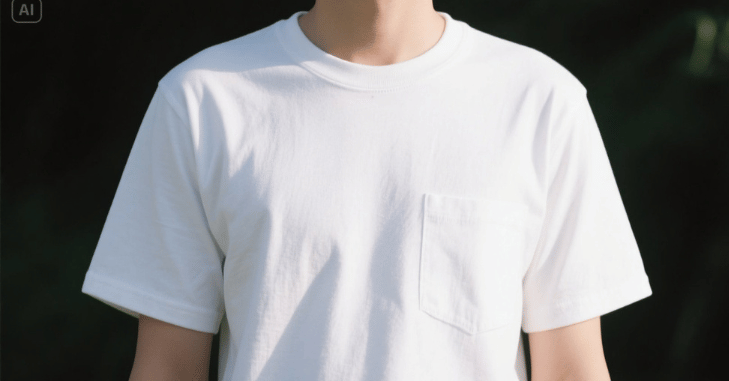
- Shoulder seam. Should land at the outer edge of your shoulder bone. Past it, the shirt looks borrowed; short of it, the sleeves pull.
- Chest, measured flat, armpit to armpit. Should be about 1–2 inches wider than half your chest circumference for a standard fit, more for a relaxed one.
- Body length. Should reach the bottom of your fly, or roughly 2 inches past your waistband. A tee that covers your entire seat was cut for a different silhouette.
- Sleeve length. Around mid-bicep for a classic fit. Shorter reads athletic, longer reads relaxed — both are fine, as long as it is a choice.
Do the shrinkage arithmetic before you buy. On an untreated cotton tee with a 28-inch body, a 4% shrink is about 1.1 inches of length and roughly three quarters of an inch across the chest, which is the difference between a shirt that tucks and one that does not. Pre-shrunk fabric has been relaxed before cutting and typically moves 1 to 2% instead. “Garment-dyed” shirts almost always shrink more than the label suggests, because the dyeing happens after construction and puts the finished shirt through additional agitation.
Three fit families cover almost the whole market. Classic is straight through the body with a set-in sleeve — the most versatile, works tucked or untucked. Slim tapers at the waist and is the only one that reliably layers under a jacket without bunching. Relaxed or oversized is wide and short-bodied, deliberately boxy, and only looks right in a midweight or heavier fabric; lightweight oversized just looks like the wrong size. Watch the drop-shoulder detail on oversized cuts: it is a design choice, not a fitting error, but it only works if the seam lands two to three inches down the arm rather than somewhere ambiguous.
What each price tier actually buys you in 2026
Prices in this category have moved up, and the reason is worth understanding because it changes how you shop. It is not the cotton. Raw cotton is cheap by historical standards. What changed is trade policy. The average effective US tariff rate rose from about 2.5% at the start of 2025 to roughly 27% by April that year, the highest in over a century; after subsequent negotiations and a Supreme Court ruling in February 2026 that struck down one of the legal bases for those tariffs, the average effective rate stood at about 12.1% as of July 2026. Separately, the de minimis exemption — the rule that let packages worth under $800 enter the United States duty-free — closed globally on 29 August 2025 and has stayed closed. That second change is the one most consumers actually feel, because it ended the model where ultra-cheap tees shipped direct from an overseas warehouse arrived with no duty attached.
| Price | What you get | Realistic lifespan |
| $8–15 | Carded open-end cotton, 18–20 singles, often tubular. Fine as an undershirt or for painting | 10–20 washes before the collar goes |
| $20–40 | Combed ring-spun 30 singles, side-seamed, stated weight. The value sweet spot | 2–3 years of weekly wear |
| $45–80 | Supima or long-staple cotton, 40 singles, better collar tape, more considered fit | 3–5 years, and it still looks good at the end |
| $90–170 | Sea Island cotton, loopwheel or vintage-machine knits, small-batch production | Excellent, but you are also paying for provenance |
| $200+ | Designer branding on fabric that is often mid-tier | Varies wildly; check the weight and yarn before assuming |
The honest conclusion has not changed, only the numbers: the curve flattens hard after about $70. The difference between a $12 tee and a $35 tee is enormous and immediately obvious. The difference between a $80 tee and a $220 one is mostly about who made it and where. One genuinely new consideration is that domestically made tees, which used to carry a large price premium over imports, now sit closer to the imported mid-tier than they did in 2024, because the imports absorbed the duty and the domestic ones did not.
The label detail nobody checks: chemical finishes
Per- and polyfluoroalkyl substances, the “forever chemicals”, appear in apparel for a specific reason: they are what make a fabric shed water, resist oil stains and shrug off wrinkles. On a white shirt, that sounds appealing. It is also now restricted. California’s AB 1817 prohibited the manufacture, distribution or sale of new textile articles containing regulated PFAS from 1 January 2025, with a threshold of 100 parts per million of total organic fluorine that tightens to 50 ppm on 1 January 2027. The law defines “textile” broadly enough to cover cotton, and it requires manufacturers to supply a certificate of compliance to sellers. Several other states have passed comparable measures, and a number of large apparel brands committed to phasing the chemistry out ahead of the deadlines.
The practical shopping rule is simple. A plain cotton T-shirt has no functional need for a stain-release or wrinkle-free finish, and those finishes make the fabric less breathable and less absorbent anyway. If a white tee is marketed as easy-care, stain-resistant or wrinkle-free, skip it and buy the plain one. If you want the reassurance of a test, OEKO-TEX Standard 100 certification screens finished products for harmful substances, including fluorinated compounds, and is the most widely available mark on basic cotton garments.
How to keep a white T-shirt actually white
Most white tees are not worn out when they get retired — they are discarded because they went gray, yellow, or developed stiff underarm patches. All three are preventable, and one of them is mostly a chemistry problem that has an easy answer.
Start with the thing almost no guide mentions: a new white tee is whiter than cotton actually is. Textile finishers apply optical brightening agents, fluorescent compounds that absorb ultraviolet light and re-emit it as visible blue, which cancels out cotton’s natural yellow cast. Those brighteners wash out gradually, which is why a shirt can look duller after twenty or thirty washes without being stained at all. Detergents marketed for whites replace them, which is why switching to a brightener-free “free and clear” detergent often makes whites look worse even though nothing is dirty. If your whites have gone flat rather than yellow or gray, the fix is a detergent containing optical brighteners, not more bleach.
- Wash whites separately, and only with whites. Gray is not dirt; it is dye transfer accumulated a fraction at a time.
- Wash cold or warm, around 85–105°F, and turn the shirt inside out. Hot water sets protein stains and accelerates shrinkage.
- Skip chlorine bleach. This is counterintuitive and important: chlorine reacts with the proteins in sweat and body oils and with residual detergent, and over repeated washes it turns cotton yellow rather than white. It also degrades cellulose, thinning the fabric. Use an oxygen bleach (sodium percarbonate) instead — the powder sold as OxiClean and similar. Oxygen bleach works best in warm water, around 105°F, and does very little in cold.
- Skip fabric softener too. It leaves a waxy coating on the fibers that traps odor and blocks absorbency. If you want softness, use less detergent, not more product.
- Treat underarm yellowing before it sets. The stain is aluminum from antiperspirant bonding with sebum. Soak the affected area in warm water with oxygen bleach for two to four hours, or make a paste of baking soda, hydrogen peroxide and a little dish soap and leave it for an hour before washing.
- Strip-wash once or twice a year. A long soak in hot water with oxygen bleach and a little washing soda pulls out accumulated detergent residue, body oil and mineral deposits from hard water. It is dramatic on shirts that have gone dingy without any obvious stain.
- Never tumble dry a stained shirt. Heat sets stains permanently. Check the shirt after washing and re-treat before it sees a dryer.
- Line dry in sunlight when you can. Ultraviolet light is a genuine natural whitener for cotton, and it costs nothing.
- Do not overload the machine. Crowded loads do not rinse properly, and leftover detergent is one of the main causes of dinginess.
- Do not store a shirt dirty. Invisible body oils oxidize over months in a drawer and surface as yellow patches that were not there when you put it away. Anything going into long-term storage should be washed first and kept out of plastic.
One habit change matters more than any product: let antiperspirant dry completely before you put the shirt on. Most underarm damage happens in the first thirty seconds of wear. If you already have shirts with hardened underarm patches, an enzyme presoak breaks down the protein component that oxygen bleach alone will not touch.
From Navy issue to Hollywood shorthand
The garment’s rise is unusually well documented. The US Navy adopted a crew-neck cotton undershirt as issued kit around 1913, and by the First World War American servicemen were wearing them as working layers in hot conditions. Sears was selling them by mail order in the 1930s for well under a dollar. Through the 1940s they remained, formally, underwear — and the Second World War did the rest, returning millions of men to civilian life already comfortable wearing one on its own.
Two films finished the job. Marlon Brando in A Streetcar Named Desire (1951) and James Dean in Rebel Without a Cause (1955) wore the T-shirt as an outer garment, and it instantly acquired a meaning: unbuttoned, unbothered, faintly dangerous. Sales of undershirts as outerwear climbed through the decade.
The next shift was technical. The commercialization of plastisol screen-printing ink at the end of the 1950s made cheap, durable printing possible, and the T-shirt became a surface: band merchandise, protest slogans, campaign shirts, souvenirs. The plain white version survived alongside all of it as the neutral option — the one that says nothing on purpose.
Its most-cited modern moment is a menswear footnote: the white tee Daniel Craig wears in Casino Royale (2006) was a Sunspel Riviera, and the resulting demand is a large part of why a heritage British underwear maker is now a name that people who do not follow fashion recognize. The pattern repeats every few years — a plain tee on the right person sells out a small factory’s annual production — which is itself a decent argument for judging the shirt by its specification rather than its story.
How to style it without looking like you gave up
- Under a jacket. A slim-fit tee in a midweight fabric under an unstructured blazer or a leather jacket. The tee must be opaque and the shoulder seam must be right, because the jacket frames both.
- With straight or tapered denim. The default, and it works because the proportions are simple. A half tuck keeps the waistline visible without looking formal.
- Oversized with tailored trousers. A heavyweight boxy tee against a wide, sharp trouser is the most current version of the look. It fails if the tee is flimsy, which is the single most common mistake in the category.
- Layered. Under an open overshirt, a cardigan, or a hoodie — our guides to the best hoodies for women and the best hoodies for men cover what layers well over a tee without adding bulk at the collar.
- Proportion for shorter frames. Shorter body length and a higher-rise bottom keep the leg line long; the same principle we cover in our guide to jeans for short women.
- Tucked with a skirt. Full tuck, midi or maxi skirt, one piece of substantial jewelry. The tee’s plainness is what makes the rest read as deliberate — the same logic that lets a maximalist wardrobe work, as anyone who has looked through Cher’s stage outfits can see from the opposite direction.
- As a base for a visible bra or bralette. If that is the intent, buy for it: 5.5 oz or heavier, or an interlock knit. A lightweight tee makes the choice look accidental rather than styled.
The environmental math, and what to do about it
A single cotton T-shirt is frequently estimated to require around 2,700 liters — roughly 700 gallons — of water across cultivation and manufacture, a figure popularized by WWF. It is worth knowing what that number is and is not. It is a global average that combines green water (rainfall the crop would have received anyway) with blue water (irrigation actually drawn from rivers and aquifers), and the split varies enormously by growing region: rain-fed cotton in parts of Brazil and West Africa uses very little irrigation, while cotton from heavily irrigated basins uses a great deal. The headline figure is useful for scale and misleading for comparison. Conventional cotton is also a heavy pesticide crop, which is a separate and less disputed concern.
The counterweight is straightforward: a well-made tee lasts several years while a cheap one lasts a season, so the highest-impact decision is buying fewer and keeping them longer. Washing at lower temperatures and line drying cut the use-phase footprint, which for a garment worn and washed weekly is a substantial share of its lifetime total.
If you want to shop more carefully, three labels are worth knowing. GOTS (Global Organic Textile Standard) certifies organic fiber content plus environmental and social criteria through the entire processing chain, with annual on-site audits and transaction-level verification. OEKO-TEX Standard 100 tests the finished product for harmful substances and is the easiest one to actually find on a basic tee. Supima licensing verifies the fiber claim rather than the farming method. Recycled-cotton blends reduce virgin fiber demand but have shorter fibers and therefore lower durability, which partly offsets the benefit — a recycled-content tee that lasts half as long is not obviously a win.

A sensible buying strategy
Buy three, not one. A rotation of three midweight combed ring-spun tees, worn in turn and washed properly, will outlast six cheap ones bought over the same period and cost less in total. Rotation matters more than it sounds: cotton fibers recover between wears, and a shirt worn three days running and then washed wears out measurably faster than the same shirt in a rotation.
Replace them together when the collars go, which is usually the first failure point. Buying a matched set also means they fade at the same rate, so you never have the problem of one visibly newer white among two older ones.
Keep a fourth as the designated undershirt — a cheap one is fine for that job, since nobody sees it and it absorbs the antiperspirant damage that would otherwise ruin a good shirt. And when a good tee finally does yellow past saving, it becomes the paint shirt, then the rag. That is the whole lifecycle, and for a garment that costs $30 and lasts three years it is a better deal than almost anything else you will buy.
Frequently Asked Questions
What is the best fabric weight for a plain white T-shirt?
Between 5 and 6.5 ounces per square yard, or roughly 180 to 220 gsm. To convert, multiply ounces per square yard by 33.9. That range is opaque enough not to show skin or an undershirt through white fabric, comfortable in most temperatures, and durable enough for years of regular wear. Anything under 4.5 oz will be noticeably see-through in white.
What does “30 singles” mean on a T-shirt label?
It is the yarn count, sometimes written 30/1, and it describes how fine the thread is. Higher numbers mean finer yarn and a smoother fabric at the same weight. Promotional blanks are usually 18 or 20 singles, good retail tees are 30, and premium basics are often 40. It is the number that tells you whether a heavy shirt will feel substantial or simply coarse.
Why do white T-shirts turn yellow under the arms?
Aluminum compounds in antiperspirant bond with sebum and sweat proteins in the fabric, and heat from the dryer sets the result permanently. Chlorine bleach makes it worse, not better, because chlorine reacts with those same proteins. Treat the area with an oxygen bleach soak or a hydrogen peroxide and baking soda paste before washing, use an enzyme presoak on hardened patches, and let deodorant dry fully before dressing.
Why do my white T-shirts look dull even though they are clean?
Optical brighteners have washed out. Cotton is naturally slightly yellow, and textile finishers apply fluorescent compounds that absorb ultraviolet light and re-emit it as blue to cancel that cast. Those brighteners wear off over twenty to thirty washes. Detergents formulated for whites replace them, which is why switching to a brightener-free detergent often makes whites look worse without anything being dirty.
Should I use bleach on a white T-shirt?
Not chlorine bleach. It weakens cotton fibers and causes yellowing over repeated use. Oxygen bleach, sold as sodium percarbonate or under brand names such as OxiClean, whitens effectively without the yellowing reaction and is safe for regular use on cotton. It needs warm water, around 105°F, to work properly; in cold water it does very little.
Should I avoid “wrinkle-free” or “stain-resistant” white T-shirts?
Yes. Those properties usually come from fluorinated chemistry, and a plain cotton tee has no functional need for them. California’s AB 1817 banned new textile articles containing regulated PFAS from 1 January 2025, at a threshold of 100 parts per million of total organic fluorine that drops to 50 ppm on 1 January 2027, and several other states have comparable rules. Beyond compliance, those finishes make fabric less breathable and less absorbent. Look for OEKO-TEX Standard 100 certification if you want the finished garment tested.
How much should I spend on a plain white T-shirt in 2026?
The $20–40 range is the sweet spot for combed ring-spun cotton with side seams and a stated fabric weight. That band has moved up from where it sat in 2024, largely because of tariffs and the closure of the $800 de minimis import exemption in August 2025 rather than anything to do with cotton, which is historically cheap at about $0.81 a pound. Between $45 and $80 you get long-staple cottons and better finishing, a real but smaller improvement. Above roughly $90 you are largely paying for provenance and branding.
How do I stop a white T-shirt from going see-through?
Buy heavier fabric. Weight is the single variable that controls opacity, so choose 5 oz or above, and prefer interlock knits or double-layer constructions if you need maximum coverage. Fabric that has thinned with age cannot be fixed — at that point the shirt has reached the end of its life.
What is the difference between combed and ring-spun cotton?
Ring-spun describes how the yarn is twisted — tightly, producing a smoother and stronger thread than cheap open-end spinning. Combing is an additional step that removes the shortest fibers before spinning. Combed ring-spun cotton therefore has fewer loose fiber ends, which means it feels softer, pills far less, and keeps its appearance longer.
How much will a cotton T-shirt shrink?
Untreated cotton shrinks 3 to 5% on a first hot wash, which on a 28-inch body length is about an inch. Pre-shrunk fabric typically moves 1 to 2%. Garment-dyed shirts usually shrink more than their labels suggest, because dyeing after construction subjects the finished shirt to extra agitation. Washing cold and skipping the dryer limits shrinkage in every case.