

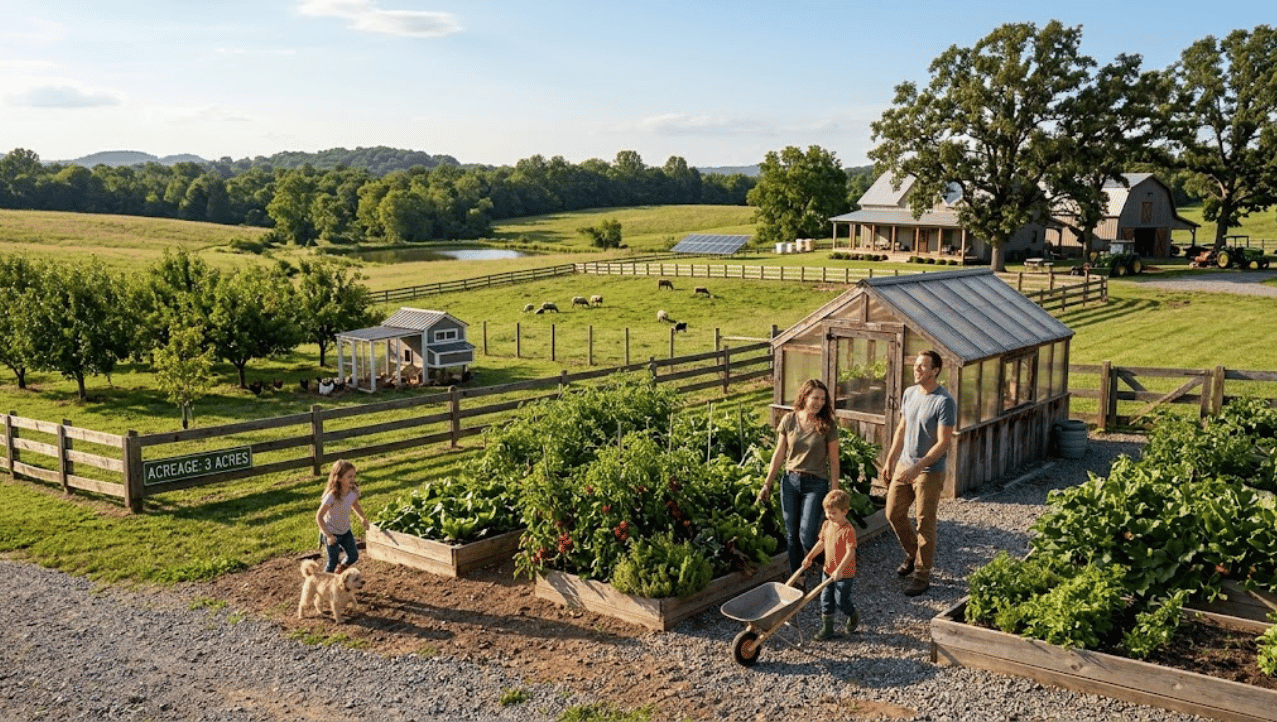
Buying 3 acres of land gives you far more room than a typical suburban lot. The property could support a home, a large yard, a garden, a workshop, or several outdoor uses. Yet acreage alone never tells you what a parcel can legally or practically support.
3-Acre Property Facts at a Glance
| Measurement or Detail | Amount |
|---|---|
| Total area | 130,680 square feet |
| Square yards | 14,520 square yards |
| Hectares | About 1.21 hectares |
| Square-shaped dimensions | About 361 feet by 362 feet |
| Full football fields | About 2.27 fields |
| Quarter-acre lots | 12 |
| Best suited for | Homes, gardens, recreation, hobby farming |
| Main buying checks | Zoning, access, utilities, drainage, septic feasibility |
Direct answer: Three acres equal 130,680 square feet and cover about 1.21 hectares. A square parcel would measure roughly 361 feet on each side. That space can accommodate a house, yard, garden, detached structures, and recreational areas, although zoning, setbacks, soil conditions, utilities, and access determine what you can build.
Key Takeaways
- Three acres provide 130,680 square feet of total area.
- Parcel shape can matter almost as much as total acreage.
- A house and several outdoor features can often fit comfortably.
- Local zoning controls permitted buildings, animals, and property uses.
- Septic suitability depends partly on soil, slope, and local requirements.
- Flood risk, road access, easements, and utilities deserve review before purchase.
How Big Is 3 Acres of Land?
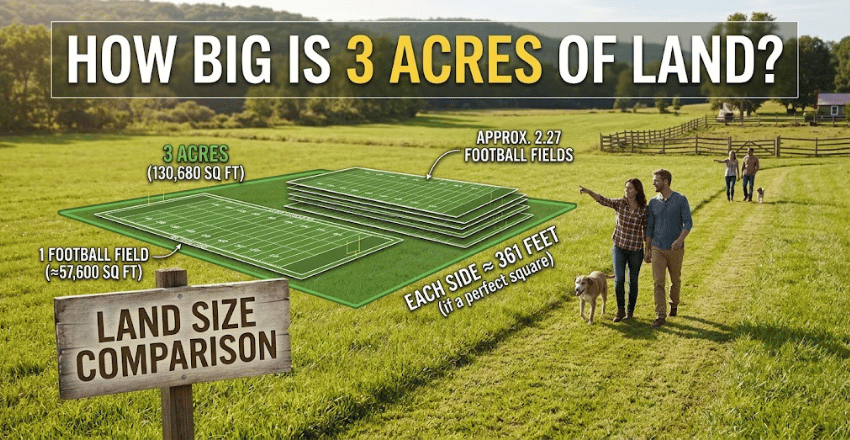
The National Institute of Standards and Technology defines one acre as exactly 43,560 square feet. Multiplying that figure by three produces 130,680 square feet. That gives buyers a more useful measurement than acreage alone.
If the parcel formed a near-perfect square, each side would measure about 361 feet. Real properties rarely have such tidy boundaries. Long road frontage, narrow sections, slopes, or irregular corners can change how spacious the property feels.
A full American football field covers roughly 57,600 square feet within its outer dimensions. Three acres are therefore about 2.27 full football fields. That comparison offers a practical way to picture the space before visiting a property.
Other Ways to Picture 3 Acres
Football fields are only one yardstick. These comparisons can help if you think in metric units or smaller lots:
- Metric size: 3 acres is about 12,141 square meters, or roughly 1.21 hectares.
- One acre as a square: a single acre laid out as a square is about 208.7 feet per side, so three of those placed in a row would form a strip about 209 by 626 feet.
- Suburban lots: it equals twelve quarter-acre house lots, before any land is set aside for roads or sidewalks.
- Tennis courts: with the run-off space usually recommended around each court (about 60 by 120 feet), roughly 18 courts would fit.
- Soccer pitches: a full-size 105 by 68 meter pitch covers about 1.76 acres, so 3 acres is a little under two pitches.
Some online guides list a 3-acre square as about 372 feet per side. The correct figure is closer to 361 feet, because the square root of 130,680 is about 361.5.
What Can Fit on a Three-Acre Parcel?
A well-shaped parcel can hold a substantial single-family home while leaving generous outdoor space. A detached garage, workshop, pool, garden, or play area may also fit. Required setbacks and septic areas can reduce the usable building envelope.
Owners interested in gardening also have considerable flexibility on this amount of ground. Vegetable beds, fruit trees, greenhouses, compost areas, and storage sheds require only part of the property. The remaining ground can provide lawn, privacy, or natural habitat.
Small-scale homesteading may also be possible where local regulations allow it. Chickens, beehives, or limited livestock may fit physically on the property. Local zoning and animal rules should always be checked before planning those uses.
How Parcel Shape Changes What You Can Do
Two properties can contain identical acreage while offering completely different layouts. A broad rectangular parcel may create several convenient building areas. A narrow parcel can lose more usable ground to setbacks and access requirements.
Road frontage can also influence driveway placement and future subdivision possibilities. Shared boundaries deserve careful review before buying. WebDorBit’s explanation of abutting property can help clarify common boundary language.
| Example Shape | Approximate Dimensions | Possible Advantage |
|---|---|---|
| Nearly square | 361 × 362 feet | Flexible central building area |
| Wide rectangle | 300 × 435.6 feet | Strong road frontage |
| Narrow rectangle | 200 × 653.4 feet | Greater depth and privacy |
| Long parcel | 150 × 871.2 feet | Separation from the road |
These examples contain roughly the same total area. They do not guarantee identical usable space. Easements, wetlands, slopes, setbacks, and utility corridors can change the practical layout.
Is Three Acres Enough for a House?
For many residential projects, the raw area is more than adequate for one house. The bigger question is whether local regulations permit the planned home. Building setbacks, lot coverage, access rules, and environmental limits can restrict placement.
Private wastewater service deserves special attention on rural land. The EPA says septic design can depend on lot size, slope, soil, occupancy, and local regulations. Local health or environmental authorities normally handle permitting and placement requirements.
Buyers should also ask whether public water, sewer, electricity, and internet reach the site. Extending utilities across undeveloped land can affect the project’s total cost. Raw acreage can therefore be inexpensive yet costly to prepare for construction.
Could You Build More Than One Home?
Physical space does not automatically allow you to build more than one home. Density limits and zoning rules can restrict a parcel to one primary residence. Minimum lot sizes can also prevent legal subdivision.
Accessory dwelling units may offer another option in communities that permit them. Rules can address structure size, parking, utility connections, and owner occupancy. Always verify current requirements with the local planning department.
A knowledgeable agent can help identify these questions before an offer becomes binding. WebDorBit’s guide to questions to ask a real estate agent provides a useful starting point. Buyers should still verify legal and planning issues through the appropriate local authorities.
What Should You Check Before Buying?
Zoning and Permitted Uses
Start with the property’s zoning designation and permitted-use table. Confirm whether your intended home, workshop, animals, or business activity is allowed. Ask about setbacks, height limits, lot coverage, and accessory structures.
Don’t rely only on the current owner’s use of the land. Existing buildings or activities may have older approvals or special exceptions. Written confirmation from the relevant jurisdiction provides stronger guidance.
Soil, Septic, and Water
A parcel without public sewer may need an on-site septic system. Soil characteristics and drainage can influence the system that authorities will approve. Poor conditions may require additional testing or a different design.
Private wells create another set of planning questions. Check water availability, local well requirements, and separation rules before building. A three-acre property still needs enough suitable ground for every required system.
Flooding and Drainage
Flat-looking land can still collect water after heavy rain. During inspection, review topography, drainage patterns, nearby streams, and visible low areas. Visiting after rainfall can reveal conditions that dry-weather tours may hide.
FEMA’s Flood Map Service Center provides official federal flood-hazard information. Buyers can search by address or location before committing to a property. Local floodplain administrators may provide additional site-specific requirements.
Access, Boundaries, and Easements
Confirm that the property has legal access from a public or approved private road. A visible dirt track does not necessarily prove permanent access rights. Title records and surveys can identify easements affecting the land.
A current survey can also clarify corners and actual boundary lines. This matters when planning fences, driveways, buildings, or future improvements. Boundary assumptions become expensive when construction has already started.
Security and Vacant-Land Monitoring
Vacant acreage may remain unattended between visits. Gates, signs, lighting, and cameras can help owners monitor common access points. Security planning becomes more useful when buildings or equipment later appear on the property.
Cellular cameras can work where traditional wired internet is unavailable. WebDorBit’s guide to cellular property cameras explains how this type of monitoring works. Local privacy and recording laws should guide camera placement.
Three Acres Compared With Common Lot Sizes
Acreage becomes easier to understand when compared with familiar residential parcels. Three acres contain twelve quarter-acre lots before roads or shared infrastructure are considered. That does not mean twelve homes can legally be constructed there.
| Property Size | Square Feet | Compared With Three Acres |
|---|---|---|
| 0.25 acre | 10,890 | One-twelfth |
| 0.5 acre | 21,780 | One-sixth |
| 1 acre | 43,560 | One-third |
| 2 acres | 87,120 | Two-thirds |
| 3 acres | 130,680 | Full property |
A larger lot can provide valuable distance between a home and neighboring properties. It also creates more mowing, fencing, drainage, and maintenance responsibilities. Buyers should consider ownership costs alongside the extra privacy.
Smart Ways to Use the Space
Residential use is often the simplest approach when zoning supports it. You could reserve one portion for the house and driveway. Another section could support gardens, recreation, storage, or natural vegetation.
Families seeking outdoor space could create trails, sports areas, play zones, or a large backyard. Gardeners could divide the site into vegetables, fruit trees, pollinator areas, and composting space. Owners seeking privacy could retain trees or establish planted buffers.
A small hobby property may support workshops, sheds, poultry, or similar activities. Each use needs enough separation from homes, property lines, wells, and septic components. Local codes should shape the layout from the beginning.
Is Three Acres a Good Amount of Land?
For many buyers, three acres balance usable space with manageable maintenance. The site can feel private without requiring the upkeep associated with a large farm. It also provides flexibility for future outdoor projects.
The best parcel isn’t always the one with the most acreage. Buildable ground, road access, drainage, utilities, location, and zoning can matter more. A smaller usable property can outperform a larger parcel with serious restrictions.
Purchase documents also deserve careful attention when land is involved. WebDorBit’s overview of contract lawyer costs explains common legal-service pricing approaches. Legal advice can be especially valuable when easements or unusual restrictions appear.
Frequently Asked Questions
How many square feet are in 3 acres of land?
3 acres of land contain exactly 130,680 square feet. The calculation uses 43,560 square feet for each acre. That measurement remains the same regardless of the parcel’s shape.
How long does it take to walk around three acres?
Walking distance depends on the parcel’s shape. A square parcel would have a perimeter of roughly 1,446 feet. That equals a little more than one-quarter mile around the boundary.
Can you farm on three acres?
Three acres can support gardens, orchards, poultry, and some small-scale agricultural activities. The practical capacity depends on climate, soil, water, and management. Local zoning may also restrict livestock or commercial farming.
Can three acres be subdivided?
Subdivision depends on local minimum lot sizes, frontage rules, utility requirements, and planning approval. Having enough physical area does not guarantee subdivision rights. Check the applicable municipal or county development rules before relying on future division.
How many houses can fit on three acres?
Several houses might fit physically, depending on their size and site layout. Zoning often determines the number that can legally be built. Septic areas, access roads, setbacks, and utility requirements may further limit density.
How big is 3 acres in square meters and hectares?
Three acres equals about 12,141 square meters, which is roughly 1.21 hectares. One acre is about 4,047 square meters.
The Bottom Line
3 acres of land offer enough room for a spacious home site and several outdoor uses. The total area is 130,680 square feet, but usable space depends on the property’s conditions. Shape, zoning, utilities, soil, drainage, and access should guide any buying decision.
Before purchasing, review official records and walk the entire parcel whenever possible. Confirm boundaries, easements, flood exposure, utility availability, and wastewater options. Those checks reveal far more about a property’s potential than acreage alone.