

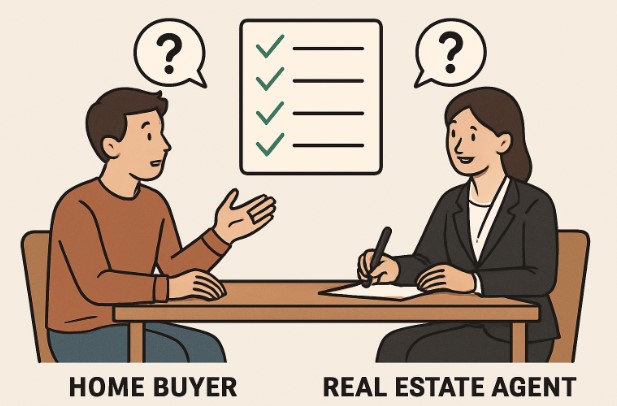
The best questions to ask a real estate agent cover five areas: their local experience and track record, how they will price and market your home (or find you one), how they are paid and what the agreement commits you to, how they negotiate, and how they communicate. Ask the same questions of two or three agents before you sign anything, and judge how clearly they answer as much as what they say.
Since the August 2024 changes to how US agents are paid, questions about fees and written agreements carry more weight than ever, especially for buyers. Below you will find the questions worth asking, grouped by topic, with notes on what a good answer sounds like and a short list of red flags.
What changed in 2024 for buyers and sellers
Following a nationwide settlement involving the National Association of Realtors, new practice rules took effect in August 2024. Offers of compensation to buyer agents can no longer be advertised on MLS listings, and buyers working with an agent who belongs to an MLS generally need a written agreement before touring homes with that agent. That agreement must state how much, or how, the agent will be paid. Commissions have always been negotiable, but the new rules put that negotiation front and center.
In practice, buyers should now ask about pay before the first showing, and sellers should decide with their agent whether to offer anything toward the buyer’s agent’s fee. Both sides benefit from getting these terms in writing early, rather than discovering them at the closing table.
Questions about experience and local knowledge
- How long have you been licensed, and is this your full-time job? A newer agent can be excellent, but ask how their broker or team supports them on pricing and negotiation.
- How many buyers and sellers did you represent in the past year, and where? Look for recent activity in your neighborhood and price range, not just a big lifetime total.
- Do you mainly work with buyers or sellers? Some agents lean one way; you want real strength on your side of the deal.
- What types of property do you know best? Condos with HOAs, older homes, new construction, rural land and waterfront homes each come with their own inspection, financing and insurance issues.
- What is happening in this market right now? A strong agent can explain inventory levels, typical days on market and how often homes sell above or below asking in your area, using current figures rather than general impressions.
Local expertise is hard to fake. In a city like Denver, for example, prices, competition and housing stock can differ sharply between neighborhoods only a few miles apart, so working with a Denver CO real estate agent Elise LoSasso, or any agent who works those specific areas day to day, gives you context a generalist may lack. Wherever you live, ask the agent to name a few streets or subdivisions they know well and what sets them apart.
Questions to ask if you are selling
- How did you arrive at the list price you are suggesting? Ask to see the comparative market analysis (CMA): recent comparable sales, active competition and adjustments for condition, size and features.
- What is your marketing plan, item by item? Expect specifics: professional photos, floor plans, video or virtual tours, online syndication, social media, open houses and outreach to other local agents.
- What should I fix or stage before listing, and what can I skip? A good agent focuses your spending on changes buyers actually pay for, such as fresh paint, decluttering and small repairs, rather than major remodels.
- How have your recent listings performed? Ask for list-to-sale price ratios and days on market compared with the local average.
- What happens if the home does not sell in the first few weeks? Listen for a plan that reviews feedback, showings and online views, not just “we will lower the price”.
- Do you recommend offering compensation to buyers’ agents? Ask how that choice could affect buyer interest and net proceeds in your market.
- What will I likely walk away with? A good agent will sketch your estimated net proceeds after commission, closing costs and payoff of your mortgage.
Questions to ask if you are buying
- What will the buyer agreement say about your pay, and how long does it last? Ask whether it can start with a short term or a single property while you see how you work together.
- How will you find homes that fit my needs, including ones not yet widely marketed? Listen for a process: saved searches, contact with listing agents and local networks.
- Should I get preapproved for a mortgage first, and who do you recommend? Many sellers expect a preapproval letter with any offer. Ask for more than one lender name so you can compare rates and fees.
- How do you make an offer competitive without taking reckless risks? Discuss escalation clauses, earnest money, inspection and appraisal contingencies, and closing timelines.
- What costs should I budget for beyond the price? Closing costs, inspections, HOA fees, homeowners insurance and property taxes all add up.
- What issues do you see often in homes in this area? An experienced local agent will know common problems, such as aging sewer lines, foundation movement or older roofs.
- Who pays you if the seller does not offer buyer-agent compensation? Make sure you understand whether you would owe the difference out of pocket and how that could be negotiated.
Questions about fees and the agreement
| Ask this | Why it matters |
|---|---|
| What is your commission, and is it negotiable? | Commissions are negotiable; know exactly what percentage or flat fee you are agreeing to |
| Are there other fees, such as administrative or transaction fees? | Some brokerages add flat fees on top of commission |
| How long is the agreement, and how can I end it? | Avoid being locked in for months if the relationship is not working |
| What type of agency relationship will we have? | States allow different arrangements, such as buyer agency, seller agency or transaction brokerage, each with different duties |
| Would you ever represent both sides of the deal? | Dual or designated agency raises conflict-of-interest questions, and some states restrict it |
| What happens to your fee if the deal falls through? | Clarifies whether anything is owed on a failed transaction |
Read the full agreement before signing, and ask for anything unclear to be explained in writing. Vague answers about pay are a warning sign in themselves.
Questions about negotiation
- How do you handle multiple offers? Sellers should ask how offers will be compared beyond price, including financing strength and contingencies. Buyers should ask how the agent helps them stand out without overpaying.
- Tell me about a recent negotiation you are proud of. A concrete story tells you more than a claim of being “a strong negotiator”.
- How do you handle inspection repairs and appraisal gaps? These are the moments where deals are saved or lost, and an experienced agent will have a clear approach to credits, repairs and price adjustments.
Questions about communication and support
- Will I work with you directly, or with a team member or assistant?
- How quickly do you usually respond, and do you prefer phone, text or email?
- How often will you update me, even when there is no news?
- Who else do you work with, such as inspectors, lenders, title companies and contractors, and do you have any financial relationship with them?
- Can I speak with two or three recent clients?
A good agent adds value well beyond the transaction itself, from contractor referrals to advice on future resale. We cover that side of the role in how agents add value beyond buying and selling.
How to compare agents after the interviews
Write down each agent’s answers on the same sheet so you can compare like with like. A simple scorecard works well:
| Criteria | What a strong answer looks like |
|---|---|
| Local track record | Recent deals in your area and price range, with numbers |
| Pricing or search approach | Clear reasoning backed by comparable sales or a defined search process |
| Marketing or offer strategy | Specific steps, timelines and examples |
| Fees and agreement | Plain terms, flexibility on length, no surprise add-on fees |
| Communication | Fast replies during the interview and a stated update schedule |
| References | Willing to connect you with recent clients |
Weight the criteria by what matters most to you. A seller in a slow market might care most about marketing; a first-time buyer may value patience and clear explanations above everything else.
Red flags to watch for
- A suggested list price far above other agents’ estimates with no solid comparable sales behind it, a tactic sometimes used to win a listing.
- Pressure to sign a long agreement on the spot.
- Vague answers about fees or about who pays whom.
- Little knowledge of your specific area or property type.
- Slow or inconsistent replies during the interview stage, which rarely improve once you have signed.
How to check an agent’s background
Every state licenses real estate agents and brokers, and most state regulators offer an online lookup where you can confirm a license is active and see any public disciplinary actions. It takes a few minutes and is worth doing for anyone on your shortlist. Online reviews help too, but look for patterns across many reviews rather than reacting to one glowing or angry comment. If you have specific lifestyle goals, such as a home near water, ask agents about their experience with those property types; our guide to what to expect from waterfront living lists issues worth raising.
If you want a printable checklist, Zillow’s comprehensive list of questions to ask a real estate agent is a useful companion to the questions above.
Final Thoughts on Choosing a Real Estate Agent
Interview at least two or three agents, ask every one of them the same questions, and get pay and agreement terms in writing before you tour or list. The right agent will answer with local numbers, a specific plan and plain fee terms. Agency and commission rules vary by state, so if anything in an agreement is unclear, ask a real estate attorney or your state regulator before you sign.
Frequently Asked Questions
How many real estate agents should I interview?
Interviewing two or three agents is usually enough to compare pricing advice, marketing plans, fees and communication style. Ask each one the same questions so the answers are easy to compare.
Are real estate commissions negotiable?
Yes. Commissions are not set by law and can be negotiated with the agent or brokerage before you sign an agreement. Ask about any extra administrative or transaction fees at the same time.
Do buyers have to sign an agreement with an agent?
Since August 2024, buyers working with an agent who belongs to an MLS generally need a written agreement before touring homes. It must state how much, or how, the agent will be paid.
What is a comparative market analysis?
A CMA compares a home with recently sold and currently listed similar properties nearby to estimate a realistic price range. Sellers should ask to see it before agreeing on a list price.
How can I check if a real estate agent is licensed?
Use your state real estate regulator’s online license lookup to confirm the license is active and check for any public disciplinary records.
What is the biggest red flag when interviewing an agent?
A list price far above other agents’ estimates with no comparable sales to support it is a common warning sign. Pressure to sign a long agreement immediately is another.
This article is general information, not legal or financial advice. Rules on agency and commissions vary by state, so confirm details with a licensed professional.