


To apply for EIN, first register your LLC, corporation or partnership with your state if that applies to you, then use the free IRS online application if your principal place of business is in the United States or a U.S. territory. There is no IRS fee, and an eligible online application can receive its number immediately after approval. Applicants who cannot use the online tool can file Form SS-4 by fax or mail, and international applicants can also apply by phone.
An employer identification number (EIN) is a nine-digit federal tax ID that the IRS uses to identify businesses and other entities. You may need one to hire employees, file certain tax returns, open a business bank account or work with vendors. This guide follows the official IRS process step by step and covers the problems that most often cause delays.
EIN application at a glance
| Key detail | What to know |
|---|---|
| What it is | A nine-digit federal tax ID assigned by the IRS |
| IRS application fee | $0 |
| Fastest method | Online application for eligible U.S.-based applicants |
| Online processing | Number may be issued immediately after approval |
| Fax processing | About 4 business days when a return fax number is supplied |
| Mail processing | Approximately 4 weeks |
| Daily limit | One EIN per responsible party per day |
| Paper application | Form SS-4 |
These timelines and rules are based on current IRS guidance. Processing can take longer when IRS inventories are high, so leave extra time if you need the number for a bank appointment or a payroll start date.
Who needs an EIN?
Not every business owner needs an EIN, so check before you apply. In general:
| Situation | EIN usually needed? |
|---|---|
| Corporation or partnership | Yes, it generally needs its own number |
| Business with employees | Yes, to report employment taxes and issue tax statements to workers |
| Sole proprietor with no employees | Not always for federal income tax purposes |
| Single-member LLC | Depends on tax treatment, employees and excise-tax obligations |
| Certain trusts, estates and retirement plans | Often, depending on the filing requirements |
| Entity filing specific federal returns, such as excise tax returns | Often required |
Even when the IRS does not require one, some owners choose to get an EIN because banks often ask for one when opening a business account, and it lets a sole proprietor give clients a tax ID other than their Social Security number. If you are not sure whether your entity needs one, the IRS guidance on your entity type or a tax professional can confirm it.
If you are forming an LLC, corporation, partnership or other legal entity, complete your state formation first. The IRS warns that applying before state registration can delay the federal application, because the legal name and entity type on your EIN should match your formation documents. For more practical reading on running a company, browse the Business section.
What you need before starting
Gather everything before you open the IRS application. The online session cannot be saved and resumed later, and it expires after 15 minutes of inactivity, so hunting for a document midway can mean starting again.
- Your legal business or organization name, exactly as registered with the state
- Your entity type (sole proprietor, LLC, corporation, partnership, trust and so on)
- Your principal business address, plus a mailing address if different
- The reason you are applying, such as starting a new business or hiring employees
- A short description of your main business activity
- The responsible party’s full name
- The responsible party’s SSN or ITIN, which the online process requires
- Signed authorization if a third-party designee will complete the application for you
- For an LLC, the number of members, which affects how the IRS classifies it
Who counts as the responsible party?
The responsible party is normally the individual who ultimately owns, controls or manages the entity and its funds. A nominee with only limited authority, such as someone who filed the formation paperwork on your behalf, cannot be listed instead. Getting this right matters, because changes to the responsible party later have to be reported to the IRS.
How to apply for EIN online in 6 steps
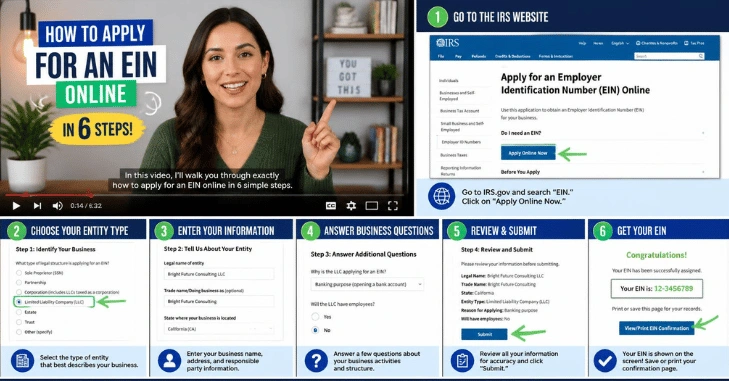
- Complete your entity formation. Register your LLC, corporation, partnership or other legal entity with the appropriate state first, when required.
- Confirm your online eligibility. The online tool is for applicants whose principal place of business is in the United States or a U.S. territory, and whose responsible party has an SSN or ITIN.
- Gather your business details. Have the legal name, entity type, address, responsible-party information and reason for applying ready using the checklist above.
- Open the official IRS application. Go to the IRS online EIN assistant. The application fee is $0, so no payment is required at any point in the process.
- Complete the application in one session. Review every entry carefully before submitting, especially the legal name and the responsible party’s details. The system does not let you save a partial application.
- Save your confirmation. If your submission is approved, download, save or print the confirmation notice before closing the session, and store it with your permanent company records.
The online tool is only available during set Eastern Time hours. Under current IRS guidance it runs Monday to Friday from 6 a.m. to 1 a.m. the following day, Saturday from 6 a.m. to 9 p.m., and Sunday from 6 p.m. to midnight. Check the IRS page before you start in case the schedule has changed.
Tips for a smooth online application
- Use a desktop or laptop with a stable connection rather than a phone on mobile data.
- Type the business name exactly as it appears on your state filing, including “LLC” or “Inc.” where applicable.
- Choose the reason for applying carefully, as it affects the questions that follow.
- Do not use your browser’s back button, which can end the session.
What if you cannot apply online?
The online tool is not the only route. Here is how the methods compare:
| Method | Who can use it | Typical timing |
|---|---|---|
| Online EIN tool | Eligible applicants with a principal place of business in the U.S. or a U.S. territory | Immediately after approval |
| Fax Form SS-4 | Domestic and international applicants using the applicable fax number | About 4 business days when a return fax number is provided |
| Mail Form SS-4 | Domestic and international applicants | About 4 weeks |
| Telephone | International applicants | Number may be assigned during the call |
Applicants whose principal place of business is outside the United States or its territories cannot use the online tool. They may submit Form SS-4 by fax or mail. International applicants may also call the IRS at 267-941-1099, Monday through Friday, from 6 a.m. to 11 p.m. Eastern Time.
This distinction matters for foreign responsible parties as well. Current Form SS-4 instructions state that a person who has no SSN or ITIN and is not eligible to get one can enter “foreign” or “N/A” on line 7b. That option applies to the Form SS-4 process, not the standard online tool.
Common mistakes that slow the process
- Applying before the entity exists. Finish state registration first when you are creating an LLC or corporation.
- Paying a third-party website. Some sites look official and charge a fee for something the IRS provides for free. The IRS states that businesses can get an EIN directly from the government at no charge.
- Listing a nominee as the responsible party. The IRS requires the person who ultimately owns, controls or manages the entity in most cases.
- Applying more than once. IRS instructions recommend using only one method for the same entity to avoid duplicate numbers, and the one-per-day limit applies across online, fax, mail and phone requests.
- Name mismatches. A legal name that differs from your state filing can cause problems with banks and later tax filings.
- Not saving the confirmation. Banks, tax professionals and vendors may ask you to verify your federal tax ID.
What to do after your number is issued
You can use your EIN for most business purposes as soon as the IRS issues it. Keep the confirmation with your permanent records, and give the number to your bank, payroll provider and accountant as needed. Next steps for many new businesses include opening a business bank account, setting up payroll if you have employees, and checking which state tax registrations apply.
If your responsible party, mailing address or business location changes later, use Form 8822-B to notify the IRS. Changes to the responsible party generally must be reported within 60 days.
A new EIN is not needed for every business change. Changing only your company’s name or address normally does not require a new number, while changes to ownership or legal structure, such as converting a sole proprietorship to a corporation, are more likely to require one. Check IRS guidance or ask a tax professional before assuming either way.
Once the administrative setup is done, you may want to explore government contracting opportunities in tech services. For agreements with clients, suppliers or partners, our guide to contract lawyer costs and options covers another common planning question.
Bottom Line
If your entity is formed and you meet the online eligibility rules, gather the checklist items and apply for EIN directly through the IRS in a single session; it costs nothing and eligible applicants can get the number the same day. There is no reason to pay an outside service. If your situation involves foreign owners, unusual ownership or tax-classification questions, speak to a qualified tax professional before submitting Form SS-4.
Frequently Asked Questions
Can I apply for EIN without an SSN or ITIN?
Not through the standard IRS online application, which requires the responsible party’s SSN or ITIN. Form SS-4 instructions provide an alternative for responsible parties who are not eligible for either number: line 7b can state “foreign” or “N/A”.
Does every LLC need an EIN?
Not necessarily for federal income tax purposes. It depends on ownership, tax classification, employees and other filing obligations. Many single-member LLCs still get one because banks often request it.
How long does it take to get an EIN?
Eligible online applicants can receive the number immediately after a successful submission. Fax applications generally take about four business days when a return fax number is provided, and mail applications take approximately four weeks.
Is an EIN the same as a business license?
No. An EIN is a federal taxpayer identification number issued by the IRS. State and local licenses, permits, registrations and tax accounts are separate requirements.
Can I get more than one EIN in a day?
No. The IRS limits issuance to one EIN per responsible party per day. The limit applies across online, fax, mail and telephone requests.
Does it cost anything to apply for an EIN?
No. The IRS charges $0 to apply for an EIN, whether online, by fax, by mail or by phone. Websites that charge a fee are third-party services, not the IRS.