

If you’ve ever wondered how to respond to thank you, the safest answer is usually “You’re welcome.” Your best reply can change with the person, setting, and size of the favor. A quick favor between friends calls for a different tone than heartfelt gratitude from a client, boss, or loved one.
Quick answer: If you need a safe response, say “You’re welcome.” For a warmer or more casual reply, try “Happy to help,” “Of course,” “Anytime,” or “No problem,” depending on the setting. In professional situations, “My pleasure” or “Glad I could help” keeps the tone polite without sounding stiff.
| Situation | Natural reply | Tone |
|---|---|---|
| Everyday conversation | “You’re welcome.” | Polite and universal |
| Small favor | “No problem.” | Casual |
| Friend or family member | “Anytime.” | Warm and friendly |
| Coworker | “Happy to help.” | Friendly and professional |
| Client or customer | “My pleasure.” | Polished |
| Boss | “Glad I could help.” | Professional |
| Heartfelt thanks | “I’m glad I could be there for you.” | Personal and sincere |
| Text or DM | “Of course!” | Short and natural |
How Do You Respond to Thank You in 4 Simple Steps?
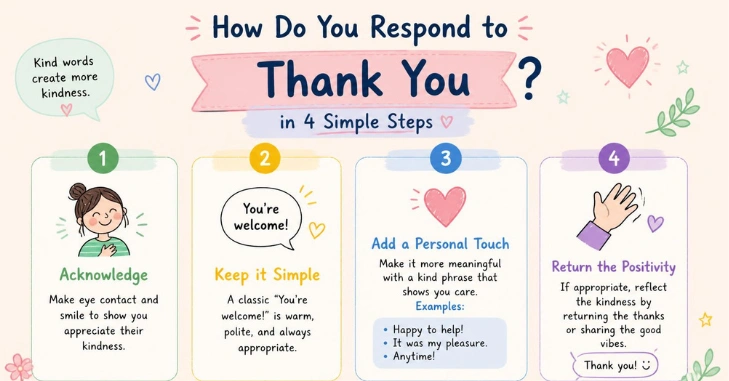
You don’t need dozens of memorized phrases to handle gratitude naturally. A better approach is to read the situation and choose a response that matches it. These four steps work for conversations, texts, workplace messages, and most social situations. There is more on this in How to respond to good luck.
What you’ll need
- A sense of how formal the situation is
- An idea of how meaningful the favor was
- A reply that sounds natural in your own voice
- Enough restraint to avoid making a simple exchange too long
- Notice the relationship. Use relaxed language with friends and close coworkers, while clients, managers, strangers, and formal contacts may call for more polished wording.
- Match the size of the gratitude. A quick “Thanks!” after holding a door does not require the same response as someone thanking you for major personal support.
- Choose the right level of warmth. “No problem” can fit a routine favor, while “I’m glad I could help” gives a meaningful thank-you more weight.
- Keep the exchange natural. Most replies need only a few words unless the other person wrote a thoughtful message or started a larger conversation.
This method keeps you from sounding rehearsed. It also prevents a common mistake: using an overly casual response when someone is expressing sincere gratitude. Once you learn to match tone instead of memorizing scripts, the right words become much easier to choose.
A Simple Tone Ladder for Choosing the Right Reply
Think of thank-you responses as a tone ladder rather than a list of interchangeable phrases. The lower end works for quick everyday interactions, while the upper end fits professional or emotionally meaningful moments. Moving one level up or down can make your reply feel much more appropriate.
| Tone level | Good responses | Best used for |
|---|---|---|
| Casual | “No problem,” “Sure thing” | Friends, quick favors |
| Friendly | “Of course,” “Anytime” | Family, familiar coworkers |
| Warm | “Happy to help,” “Glad I could help” | Work, meaningful favors |
| Polished | “My pleasure,” “You’re very welcome” | Clients, customers, formal settings |
| Heartfelt | “I’m glad I could be there for you” | Personal support, emotional gratitude |
This tone ladder is useful because the same words can feel different depending on context. “Anytime” sounds generous after helping a friend move, yet it may sound too casual after a formal business request. “My pleasure” works well with a client but can sound unnecessarily formal after passing someone the salt.
Best Everyday and Casual Responses
Casual conversations usually benefit from short replies. You can acknowledge the gratitude without turning a small exchange into a ceremony. Your tone, smile, or punctuation often communicates as much warmth as the phrase itself.
Good everyday choices include:
- “You’re welcome.”
- “No problem.”
- “Of course.”
- “Anytime.”
- “Sure thing.”
- “Happy to help.”
- “You got it.”
- “Glad I could help.”
“You’re welcome” remains the safest option when you aren’t sure what fits. Both Cambridge and Merriam-Webster recognize the phrase as a standard polite response after someone thanks you.
What to Say in a Text, DM, or Group Chat
Texts usually allow a lighter response than formal emails. “Of course,” “Anytime,” “No worries,” and “Happy to help” can close the exchange without creating unnecessary back-and-forth. A reaction emoji may also be enough when the thank-you is brief, and the conversation is clearly finished.
Match the energy of the message you received. If someone writes a warm paragraph about how much your help meant, sending only a thumbs-up may feel detached. If they send “thanks!” after you forward a link, a long three-paragraph response would feel equally out of place.
Professional Ways to Reply at Work
Professional replies should be courteous without sounding stiff. “Happy to help,” “Glad I could assist,” “My pleasure,” and “You’re welcome” work well across many U.S. workplaces. A clear response can also keep the conversation open if another task or question follows.
For example, if a coworker writes, “Thank you for reviewing my presentation,” you could answer, “Happy to help. Send it over again if you want another set of eyes on the final version.” That reply receives the thanks while giving the other person a useful next step.
Written professionalism also depends on clarity outside gratitude exchanges. Webdorbit’s guide to spelling “business” correctly in professional communication covers another small language detail that can affect how polished written communication feels. The broader Webdorbit Education section also collects practical learning and writing topics.
How to Reply When Your Boss Thanks You
When a manager thanks you, accept the recognition rather than immediately minimizing your work. “You’re welcome. I’m glad the report helped,” or “Happy to help. I enjoyed working on that project,” sounds confident and cooperative. You don’t need to turn every compliment into a speech about how little effort the task required.
This matters most when the thanks recognizes substantial work. Saying “It was nothing” after spending several evenings solving a serious problem can unintentionally erase your contribution. A gracious response lets you accept appreciation while keeping the focus on the work and the team.
What to Say When a Client or Customer Thanks You
Client-facing replies often benefit from a little more polish. “My pleasure,” “I’m glad we could help,” and “You’re very welcome” acknowledge the customer without sounding overly familiar. If there is a useful next step, you can add it after receiving their thanks.
For example, a service provider might write, “My pleasure. I’m glad we could get this resolved for you. Please reach out if the issue returns.” That format stays warm while keeping the message useful and concise.
Tone matters across all customer-facing writing, not only short email exchanges. Webdorbit’s guide to content creation services and business messaging shows how audience, brand voice, and editing also shape professional communication. Consistency becomes more important when several people communicate on behalf of one business.
How to Respond to Heartfelt Gratitude
A deeply personal thank-you deserves more warmth than “No problem.” If someone thanks you for supporting them during a difficult period, try “I’m glad I could be there for you,” or “That means a lot to hear.” These replies acknowledge the emotion instead of brushing it aside.
You can also reassure the person when the relationship supports it. “You never need to hesitate to call me,” or “I’m always happy to be there for you,” turns the reply into genuine reassurance. Keep the focus on the relationship rather than trying to come up with a clever line.
Can You Say “Thank You” Back?
Yes, reciprocal gratitude can be natural when you genuinely have something to appreciate. If a host thanks you for coming, you might say, “Thank you for having me. I had a great time.” If a client thanks you for your work, you might reply, “Thank you for trusting us with the project.”
This approach works because gratitude does not have to move in only one direction. The person may appreciate your help while you appreciate their invitation, trust, patience, or cooperation. Returning thanks works best when it refers to something specific rather than becoming an automatic politeness loop.
Is “No Problem” Rude in the United States?
“No problem” is generally a normal informal response in American English. Merriam-Webster defines it as an informal expression used when someone is happy to do something, including as a reply to thanks. The same usage discussion also notes that some people still prefer the traditional “You’re welcome.”
That difference is why context matters. “No problem” is a comfortable choice for friends, coworkers, and routine favors, but “You’re welcome,” “My pleasure,” or “Happy to help” can be safer in formal customer service or with someone whose preferences you don’t know. You aren’t choosing between a correct and incorrect phrase; you’re choosing between different levels of formality.
Responses That Can Miss the Mark
Most awkward responses fail because they either dismiss the gratitude or use the wrong level of familiarity. You don’t need to ban casual phrases, but you should notice what your wording implies. A response should acknowledge appreciation rather than make the other person feel foolish for offering it.
Be cautious with:
- “Whatever.” It can sound irritated or dismissive.
- “Obviously.” It may come across as sarcastic.
- “It was nothing.” It can minimize meaningful help.
- “You owe me.” It turns gratitude into a debt unless you use it clearly as a joke with someone close.
- No response at all. Silence can feel abrupt when the thanks was personal or substantial.
Formal social situations often depend on reading context beyond the words being spoken. Webdorbit’s guide to formal attire and social expectations illustrates the same broader principle: your choices should fit the occasion. Good etiquette is usually less about rigid rules and more about showing awareness of the people around you.
Do You Always Need to Reply to a Thank-You Message?
Not every quick thank-you needs another full message. In a fast-moving work chat, a reaction can close the exchange, and an email thread may naturally end after the sender expresses appreciation. A reply becomes more useful when the gratitude is personal, there is an unanswered question, or you want to maintain an ongoing relationship.
If you do respond, keep the size of your reply proportional to the original message. A two-word thank-you rarely needs a paragraph, while a thoughtful note may deserve several sincere sentences. The goal is to acknowledge the other person, not to keep the politeness cycle running forever.
Frequently Asked Questions
How do you respond to thank you if you want the safest answer?
“You’re welcome” is the safest general response because it works in casual, professional, and formal situations. You can make it warmer by saying “You’re very welcome” when the gratitude feels more personal. If you know the person well, “Of course” or “Happy to help” may sound more natural.
What is the best professional response?
“Happy to help” is one of the easiest professional choices because it sounds warm without becoming too casual. “My pleasure,” “Glad I could assist,” and “You’re welcome” are also strong options. With a boss or client, you can add one short sentence connecting your help to the result.
Is “anytime” a good response?
“Anytime” is friendly and signals that you would be willing to help again. It works especially well with friends, relatives, and coworkers you know well. Use a more neutral phrase if you don’t want to imply an open invitation for future requests.
Should I reply to a thank-you email?
Reply when the message is meaningful, includes another question, or comes from someone with whom you want to maintain an active professional relationship. A short “You’re welcome. I’m glad I could help” is usually enough. If the email clearly closes a routine exchange, you may not need to respond.
What should I say after someone thanks me for a gift?
Focus on their enjoyment rather than the gift’s effort or price. You could say, “I’m so glad you like it. I thought it would be perfect for you.” That reply keeps the moment warm and personal without putting attention on what you spent.