

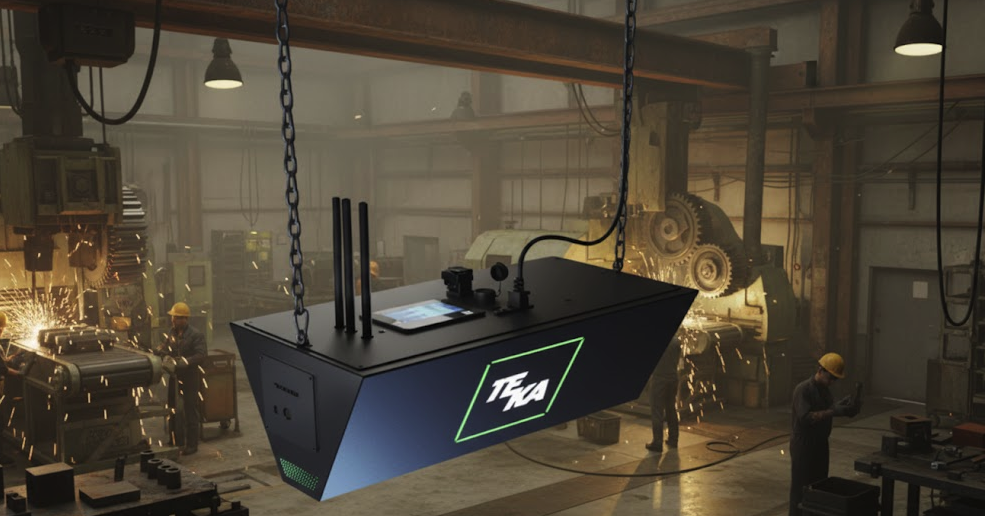
Welding air purifiers help keep a shop OSHA compliant by capturing the fine metal fume that general ventilation leaves hanging in the air, which helps keep workers’ exposure to substances such as manganese and hexavalent chromium below legal limits. On their own they are rarely the whole answer: OSHA expects employers to control fume at the source where feasible, clean the wider room with ambient filtration and verify results with air monitoring.
Integrating a welding air purifier in the early stages of your workspace layout makes those goals much easier to meet than retrofitting later. This guide explains which rules apply, how purifiers fit into a complete fume control plan, which features matter, how to size a system and how to prove it is working.
Why Welding Fume Is a Compliance Issue
Welding produces a plume of very small metal oxide particles along with gases such as ozone, nitrogen oxides and carbon monoxide. The particles are small enough to reach deep into the lungs. The International Agency for Research on Cancer classifies welding fume as carcinogenic to humans. Short-term overexposure can cause metal fume fever, and long-term exposure to certain metals has been linked to lung and neurological problems.
What is in the fume depends on the base metal, filler, coating and process, which is why a one-size approach to ventilation often falls short.
| Material or process | Main fume concern | Control priority |
|---|---|---|
| Stainless steel and some hardfacing wires | Hexavalent chromium and nickel | Source capture plus high-grade filtration; specific monitoring rules |
| Mild steel | Iron oxide with manganese | Source capture and ambient filtration |
| Galvanized steel | Zinc oxide | Strong source capture to prevent metal fume fever |
| Aluminum MIG | High ozone levels | General ventilation for gases alongside particle filtration |
Which OSHA Standards Apply
There is no single “welding air” rule. Several OSHA standards work together, and employers are responsible for keeping exposures below the applicable limits.
| Standard | What it covers |
|---|---|
| 29 CFR 1910 Subpart Q (1910.252) | General requirements for welding, cutting and brazing, including ventilation and protection in confined spaces |
| 29 CFR 1910.1000 | Permissible exposure limits (PELs) for air contaminants such as manganese, iron oxide and zinc oxide |
| 29 CFR 1910.1026 | Hexavalent chromium: a much stricter PEL, exposure monitoring and control requirements |
| 29 CFR 1910.134 | Respiratory protection program when respirators are used |
| 29 CFR 1926 Subpart J | Welding and cutting on construction sites |
OSHA also follows the hierarchy of controls: engineering controls such as local exhaust and filtration are expected before relying on respirators alone. Many states run their own OSHA-approved plans, which can be stricter than federal rules, so check your state program as well.
Where Air Purifiers Fit in a Fume Control Plan
Think of fume control in layers, with each layer catching what the one before it misses.
- Substitution and process choices: lower-fume processes or consumables where the job allows.
- Source capture: fume guns, extraction arms or downdraft tables that pull fume away before it reaches the welder’s breathing zone.
- Ambient air filtration: purifiers that continuously clean the shop air of fume that escapes capture.
- General ventilation: fresh air exchange and control of gases.
- Respiratory protection: used where monitoring shows engineering controls are not enough.
Workspaces that take air quality seriously usually combine purification units with source capture. Many shops incorporate a fume extractor for welding, creating a layered approach that removes fume directly at the arc while the purifier manages the broader airspace. Source capture protects the welder; ambient filtration protects everyone else in the building, including fitters, grinders and supervisors who may never strike an arc.
Types of Welding Air Purification Systems
| System | Best for | Limitations |
|---|---|---|
| Portable fume extractor with arm | Single bays, repair shops, varied work positions | Arm must be repositioned as the welder moves |
| Fume extraction gun | Production MIG and flux-cored welding | Heavier gun, not ideal for every joint |
| Downdraft or backdraft table | Bench welding, grinding and small parts | Only covers the table area |
| Ceiling-hung ambient air cleaners | Whole-shop background fume | Does not protect the breathing zone at the arc |
| Centralized ducted systems | Large facilities with many fixed stations | Higher installation cost and planning |
Features That Matter When Choosing a Purifier
- Filter efficiency: welding fume is sub-micron, so look for high-efficiency cartridge filters, ideally with HEPA after-filters for stainless and other hazardous work.
- Airflow and coverage: sized to the room volume and number of arcs. Suppliers typically recommend several full air changes per hour for ambient systems.
- Self-cleaning: pulse-jet cleaning extends filter life on high-duty equipment.
- Spark protection: spark arrestors reduce fire risk in the filter housing.
- Gas control: activated carbon stages help with odors and some gases, though ozone and carbon monoxide still require general ventilation.
- Monitoring: pressure gauges or filter-status indicators so you know when performance drops.
- Noise: a unit that is too loud tends to get switched off, so check operating noise near workstations.
Whether you weld aluminum, stainless or carbon steel, match the unit to the metals and processes you actually run. A shop that mostly does TIG on thin stainless has different needs from a structural fabricator running flux-cored wire all day. Our guide to modern TIG welding best practices covers setup and safety habits that also reduce fume.
Questions to ask equipment suppliers
- What filter efficiency does the unit achieve on sub-micron welding fume, and is a HEPA after-filter available?
- What airflow does the unit deliver with a partly loaded filter, not just when new?
- How often are filters typically replaced in a shop with similar processes, and what do replacements cost?
- Can you provide an airflow layout for our building and references from comparable fabrication shops?
- Is the unit suitable for recirculating air from stainless or other chromium-bearing work, or should that air be exhausted outdoors?
Sizing an Ambient System: A Worked Example
Ambient units are usually sized by room volume and the number of air changes per hour. Take a shop that is 60 feet long, 40 feet wide and 20 feet high: that is 48,000 cubic feet of air. If a supplier recommends around six air changes per hour for moderate welding, the system needs to move roughly 288,000 cubic feet per hour, or about 4,800 cubic feet per minute (CFM).
That might be delivered by two or three ceiling-hung units placed so their airflow pattern sweeps the whole space. Heavier production, more arcs or high-fume processes push the requirement up, so treat this as a starting point and have the supplier model your actual layout, including doors, mezzanines and obstructions.
Quick sizing checklist
- Measure length, width and ceiling height of the welding area
- Count the arcs that typically run at the same time
- List the metals and processes, especially stainless, galvanized and aluminum
- Note doors, fans and heaters that create cross drafts
- Ask suppliers for an airflow layout, not just a unit count
Step-by-Step Plan for a Compliant Shop
- Inventory processes, materials and the number of welders on each shift.
- Have an industrial hygienist take baseline breathing-zone samples.
- Fit source capture to the highest-fume stations first.
- Add ambient filtration sized to the room and airflow pattern.
- Confirm general ventilation handles gases such as ozone and carbon monoxide.
- Re-sample after installation to verify exposures are below the limits.
- Set a maintenance schedule and train welders on correct hood positioning.
- Document everything and repeat sampling when processes change.
Common Mistakes to Avoid
- Relying on ambient filtration alone for welders who work all day at one station.
- Placing units where cross drafts from doors or fans short-circuit the airflow.
- Recirculating filtered air from stainless or chromium work without adequate filtration grade.
- Skipping air monitoring and assuming the equipment is enough.
- Letting filters load up until airflow drops to a fraction of its rated capacity.
Proving Compliance: Monitoring and Records
Buying equipment is not the same as being compliant, because OSHA looks at actual exposure. A qualified industrial hygienist can take personal breathing-zone samples during typical work and compare the results with the PELs. For hexavalent chromium, the standard sets specific monitoring requirements.
Keep records of sampling results, equipment specifications, filter changes and training. If results are close to the limits, add source capture, adjust airflow or review work practices before relying on respirators. Good records also make it much easier to answer questions during an inspection.
Maintenance That Keeps Systems Effective
- Check filter pressure or status indicators weekly and replace filters on the manufacturer’s schedule.
- Empty dust drawers and dispose of collected fume according to local rules, since it may contain regulated metals.
- Inspect hoses, arms and ducts for leaks or crushing that cut airflow.
- Train welders to position extraction hoods close to the arc and to keep their head out of the plume.
- Re-assess when you add new processes, materials or welding stations.
Benefits Beyond Compliance
Cleaner air brings practical gains. Welders see the joint more clearly, which improves quality. Less fume settles on machinery, electronics and finished parts, reducing cleaning and rework, which matters for shops that paint or coat parts afterward; see our article on improving powder coating edge coverage on complex parts. A visibly cleaner shop also supports recruitment and a stronger safety culture, because workers can see that their health is taken seriously.
Frequently Asked Questions
Does OSHA require welding air purifiers?
OSHA does not name a specific product. It requires employers to keep exposures below permissible limits and to use engineering controls where feasible. Air purifiers and fume extractors are common ways to meet that duty.
Is a welding air purifier the same as a fume extractor?
Not quite. A fume extractor captures fume at the source near the arc, while an ambient air purifier cleans the general shop air. Most shops benefit from using both together.
Is opening doors or using fans enough ventilation?
Usually not for regular production welding. Fans can blow fume into other workers’ breathing zones and do not remove fine particles. Only air monitoring can confirm whether exposures are acceptable.
How often should filters be changed?
It depends on welding hours and materials. Follow the manufacturer’s guidance and change filters when pressure drop or status indicators show reduced airflow.
Do I still need respirators with a purifier?
Possibly. If monitoring shows exposures still exceed limits, respirators under a written respiratory protection program are required in addition to engineering controls.
Bottom Line
Welding air purifiers are a key part of an OSHA-compliant shop, but they work best as one layer in a plan that starts with source capture, adds ambient filtration sized to your space and is proven with air monitoring. Size the system to your real processes, keep filters maintained and document results, and you protect both your workers and your business.
This article is general information, not legal or occupational safety advice. Confirm requirements with OSHA, your state plan or a qualified industrial hygienist.