

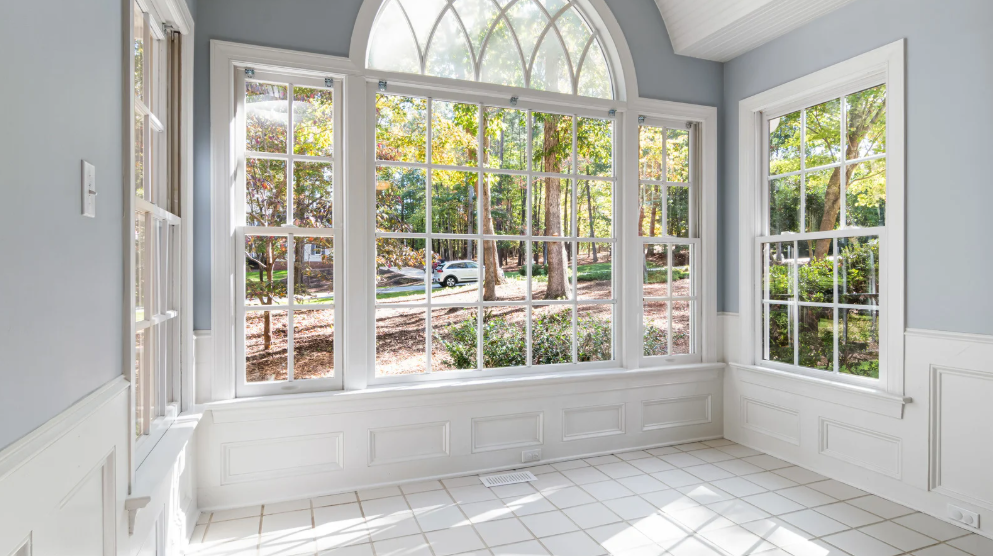
The thermal performance of a window is how well it stops heat moving through it: out of the house in winter and into the house in summer. You judge it by three numbers on the NFRC label: U-factor (lower means better insulation), solar heat gain coefficient or SHGC (lower means less solar heat gets in) and air leakage (lower means fewer drafts). In a hot, humid city like Houston, SHGC usually matters most.
That’s why professionally specified and installed windows in Houston rely heavily on low-E coatings that block solar heat while still admitting daylight. This guide explains each rating, which frame and glass choices actually change the numbers, what hot-humid climates need, how installation affects real-world results, and how to read a label before you buy.
What Thermal Performance Really Means
Heat crosses a window in three ways. Conduction moves heat through the glass and frame material. Convection moves it through air currents, both inside the gap between panes and through leaks around the sash. Radiation carries it as infrared energy and as sunlight passing through the glass. A window with strong thermal performance slows all three, not just one.
That’s why no single rating tells the full story. A window can insulate well on a cold night yet let in a lot of afternoon sun, or block the sun nicely but leak air around a poorly fitted sash. The aim is a balance that suits your climate, your home’s orientation and how you use each room.
The Ratings on the NFRC Label, Explained
In the United States, the National Fenestration Rating Council (NFRC) certifies whole-window ratings, meaning the frame, glass and spacers are tested together. That matters because a glass-only figure from a brochure will always look better than the complete window. Look for the NFRC sticker on the glass or in the product documentation, and compare products using those numbers.
U-Factor
U-factor measures how much non-solar heat flows through the whole window. It usually falls between about 0.15 and 1.2, and lower is better. It matters most in cold weather and in air-conditioned homes where you want to keep conditioned air inside. Note that U-factor is the inverse of insulation: an R-value is a resistance, while U-factor is a rate of heat flow.
Solar Heat Gain Coefficient (SHGC)
SHGC is the fraction of solar radiation that ends up as heat indoors, expressed from 0 to 1. A window with an SHGC of 0.25 admits about a quarter of the solar heat striking it. In hot climates, a low SHGC is often the single biggest factor in reducing air conditioning load.
Visible Transmittance, Air Leakage and Condensation Resistance
Visible transmittance (VT) shows how much daylight passes through; higher means brighter rooms. Air leakage is listed in cubic feet per minute per square foot, and good windows are typically at or below 0.3. Condensation resistance, when shown, runs from 1 to 100, with higher numbers meaning the inside glass is less likely to fog or drip.
| Rating | Range | Better is | Matters most for |
|---|---|---|---|
| U-factor | About 0.15 to 1.2 | Lower | Keeping conditioned air in, cold-weather comfort |
| SHGC | 0 to 1 | Lower in hot climates | Cooling costs and sun-facing rooms |
| Visible transmittance | 0 to 1 | Higher | Natural light |
| Air leakage | Cfm per sq ft | Lower (0.3 or below) | Drafts and humidity entry |
| Condensation resistance | 1 to 100 | Higher | Fogging and moisture on glass |
Typical Ratings by Glass Package
Exact values vary by manufacturer and frame, but these approximate whole-window ranges show how much the glass package matters:
| Glass package | Approx. U-factor | Approx. SHGC | Best suited to |
|---|---|---|---|
| Single pane, clear | 0.9 to 1.2 | 0.6 to 0.8 | Sheds, unconditioned spaces |
| Double pane, clear | 0.45 to 0.55 | 0.5 to 0.7 | Mild climates on a tight budget |
| Double pane, low-E, argon | 0.25 to 0.32 | 0.2 to 0.4 | Most U.S. homes, including the South |
| Triple pane, low-E, argon or krypton | 0.15 to 0.22 | 0.2 to 0.35 | Cold northern climates, noisy streets |
Low-E coatings are microscopically thin metal oxide layers. Low-solar-gain versions reflect much of the sun’s infrared heat, which suits Texas and the Gulf Coast. High-solar-gain versions let more winter sun in and are more common in northern states. Some manufacturers offer several low-E options on the same frame, so ask which coating a quote includes rather than assuming.
How Frame Materials Compare
The frame can make up 15 to 30 percent of the window area, so its material has a real effect on the overall U-factor.
| Frame | Insulation | Maintenance | Hot-humid suitability |
|---|---|---|---|
| Vinyl | Good (hollow chambers) | Low | Good; check weld quality and color heat limits |
| Fiberglass | Good | Low | Very good; stable in heat and sun |
| Wood / clad wood | Good | Higher | Fair; needs moisture protection |
| Aluminum (thermally broken) | Fair | Low | Acceptable only with a thermal break |
| Composite | Good | Low | Good |
- Vinyl: insulates well thanks to hollow chambers, needs little upkeep and is usually the most affordable. Quality varies, so check that corners are welded and chambers are well designed.
- Fiberglass: insulates about as well as vinyl, expands and contracts at a rate close to glass, and holds up well in heat and sun. Typically costs more than vinyl.
- Wood and clad wood: naturally insulating and attractive, but needs more upkeep, especially in humid climates.
- Aluminum: strong and slim but a strong heat conductor. Consider it only with a thermal break, a resin or plastic barrier separating the inner and outer frame.
- Composite: blends of wood fiber and polymers that aim to combine wood’s look with vinyl’s durability.
Spacers matter too. The strip separating the panes was traditionally aluminum, which creates a cold (or hot) edge. Warm-edge spacers made from foam, stainless steel or composite reduce heat flow at the perimeter and lower the risk of condensation around the glass edges.
What Houston and Other Hot-Humid Climates Need
Houston sits in climate zone 2A under the International Energy Conservation Code, a hot and humid zone where cooling dominates the energy bill for most of the year. ENERGY STAR’s Southern zone criteria call for a U-factor of 0.40 or lower and an SHGC of 0.23 or lower, and local energy codes based on the IECC set similar limits for new work. In practice, that points most Houston homeowners toward double-pane, low-solar-gain low-E glass with argon fill.
Humidity adds a second concern. When cool, air-conditioned indoor air meets warm, humid outdoor air, condensation can form on the outside of the glass or, worse, inside the wall around a badly sealed window. Good flashing, a continuous air seal and a frame that doesn’t act as a thermal bridge all reduce that risk. For homes where moisture already shows up lower in the house, our guide to basement wall vapor barriers covers the same principles of controlling where water vapor goes.
Storms are a further local factor. Along the Gulf Coast, some homeowners choose impact-rated glass, which uses laminated layers. Laminated glass can carry low-E coatings too, so you don’t have to give up thermal performance for storm protection; just confirm the NFRC numbers for the exact impact unit quoted.
Signs Your Current Windows Perform Poorly
- Rooms near windows feel noticeably hot in summer afternoons or drafty in winter.
- Fog or moisture appears between the panes, a sign the seal has failed.
- You can feel air moving around closed sashes on a windy day.
- Furniture and flooring near sunny windows fade quickly.
- Your air conditioner runs constantly on sunny days even when set reasonably.
- Single-pane glass or non-thermally-broken aluminum frames, common in older homes.
If only one or two symptoms apply, cheaper fixes such as new weatherstripping, caulking or interior shading may be enough. If several apply, replacement is often worth pricing.
Why Installation Matters as Much as the Product
The NFRC label describes the window in a test chamber, not in your wall. Gaps around the frame, missing insulation in the rough opening or poor flashing can erase much of the benefit you paid for. A careful installer will typically:
- Check the rough opening for rot, square and level before setting the unit.
- Shim the frame so the sash closes evenly and the weatherstripping compresses fully.
- Fill the gap between frame and framing with low-expansion foam or backer rod, never with high-expansion foam that can bow the frame.
- Integrate flashing tape with the house wrap in the correct shingle order so water drains outward.
- Seal the interior perimeter to stop air leakage and test every sash and lock.
Ask any contractor how they handle each of these steps. Clear, specific answers are a good sign the rated performance will carry through to your home.
Orientation, Window Style and Room-by-Room Choices
Where a window faces changes what you should prioritize. West-facing glass takes the harsh late-afternoon sun and south-facing glass gets strong sun much of the day, so both benefit from the lowest SHGC you can find, plus shading from overhangs, trees or awnings. North-facing windows receive gentle, indirect light and can use glass with higher visible transmittance for brighter rooms. East-facing windows take morning sun, which is less intense but still worth managing in bedrooms.
Window style affects air leakage. Casement and awning windows press against their seals when closed and tend to post lower air leakage figures, while sliders and double-hung windows rely on sliding weatherstripping that can wear over time. Fixed picture windows are usually the tightest of all. If you’re weighing styles room by room, this comparison of different window types is a practical way to match function, ventilation and efficiency to each space.
Interior treatments add a final layer. Cellular shades, lined drapes and even simple options such as paper window shades cut summer heat gain on sunny exposures, though they supplement good glass rather than replace it.
Costs and Savings: What to Expect
Installed prices vary widely with size, frame material, glass package and how much repair the openings need. As a rough guide, many U.S. homeowners see installed costs of a few hundred dollars per window for basic vinyl replacements and well over $1,000 per window for fiberglass, wood or large custom units. Get two or three written quotes that list the exact NFRC ratings of the proposed products so you compare like with like.
Savings depend on what you’re replacing. Swapping single-pane, clear glass for low-E double-pane windows usually makes a noticeable difference to comfort and cooling bills, while replacing ten-year-old double-pane units brings a much smaller gain. Efficient windows also reduce the load on your cooling system, which can make a smaller or smarter unit, such as the models in our guide to WiFi air conditioners, cheaper to run. Check current federal tax credit rules on IRS.gov and ask your utility about rebates before you buy, since incentives for efficient windows have changed in recent years. A tax professional can confirm whether a specific purchase qualifies.
Replace or Upgrade? Lower-Cost Ways to Improve Existing Windows
Full replacement isn’t the only option. If your frames are sound and the glass is already double pane, several lower-cost steps can improve comfort while you plan a larger project:
- Weatherstripping and caulk: replacing worn seals and resealing the interior trim cuts air leakage, often for the cost of materials and an afternoon.
- Exterior shading: awnings, solar screens and well-placed trees stop sunlight before it reaches the glass, which is more effective than interior blinds in hot climates.
- Professionally installed window film: spectrally selective films can lower solar gain on older clear glass; check that the film won’t void the glass warranty.
- Insulating window treatments: cellular shades closed during the hottest hours on west-facing rooms reduce heat entering the living space.
These measures won’t match a new low-E unit, but they can make a real difference in a single problem room.
Common Mistakes When Choosing Energy-Efficient Windows
- Comparing glass-only figures instead of NFRC whole-window ratings.
- Choosing a northern-style high-solar-gain coating for a Texas home.
- Paying for triple pane where a well-specified double pane would do.
- Picking the cheapest installer and losing performance to gaps and poor flashing.
- Ignoring orientation and using the same glass on every side of the house.
A Quick Checklist Before You Buy
- Confirm the product has an NFRC label and note its U-factor, SHGC, VT and air leakage.
- Match ratings to your climate zone, using ENERGY STAR criteria as a minimum.
- Choose low-solar-gain low-E glass for west and south exposures in hot regions.
- Pick an insulating frame (vinyl, fiberglass, wood or thermally broken aluminum) and ask about warm-edge spacers.
- Get the installation method in writing, including flashing and air sealing.
- Read the warranty for glass seal failure, frame defects and labor.
Bottom Line on Window Thermal Performance
Judge windows by their NFRC whole-window ratings, not marketing claims. In Houston and similar hot-humid climates, prioritize a low SHGC (around 0.23 or below), a U-factor of 0.40 or lower, low air leakage and an insulating frame, then insist on careful installation. That combination delivers cooler rooms, lower cooling bills and fewer moisture problems.
Frequently Asked Questions
What is a good U-factor for windows?
It depends on climate. In hot southern areas such as Houston, a U-factor of 0.40 or lower meets ENERGY STAR criteria, and many low-E double-pane windows land around 0.25 to 0.30. Cold northern climates call for much lower values, often 0.22 or below.
Is U-factor or SHGC more important in a hot climate?
In hot, sunny climates SHGC usually has the bigger effect on cooling costs, because solar heat through the glass is the main load. Aim for an SHGC around 0.25 or lower while keeping a reasonable U-factor.
Are triple-pane windows worth it in Texas?
For most Texas homes, a well-specified double-pane low-E window gives most of the benefit at a lower cost. Triple pane can make sense for noise reduction or very large west-facing glass, but the extra insulation pays back more slowly in a mild-winter climate.
Does argon gas leak out of windows over time?
A small amount escapes slowly over many years, but a well-sealed unit keeps most of its fill for a long time. Fogging between the panes signals a failed seal, which is usually covered by the glass warranty.
Can poor installation ruin an energy-efficient window?
Yes. Air gaps, missing insulation around the frame and bad flashing can cause drafts, condensation and water damage that cancel out the rated performance. Careful professional installation is what turns label numbers into real comfort.