

Most flank steak nutrition pages hand you one number and stop. That figure is almost always for cooked meat, but the piece in your cart is raw. The gap between those two weights is where calorie tracking quietly falls apart.
Here you get the USDA figures for a cooked portion and the raw weight sitting behind it. You also get what oil and marinade add on top, plus how flank steak nutrition lines up against skirt, flat iron and top sirloin. Portions are cooked weight unless the text says otherwise.
Flank steak nutrition at a glance
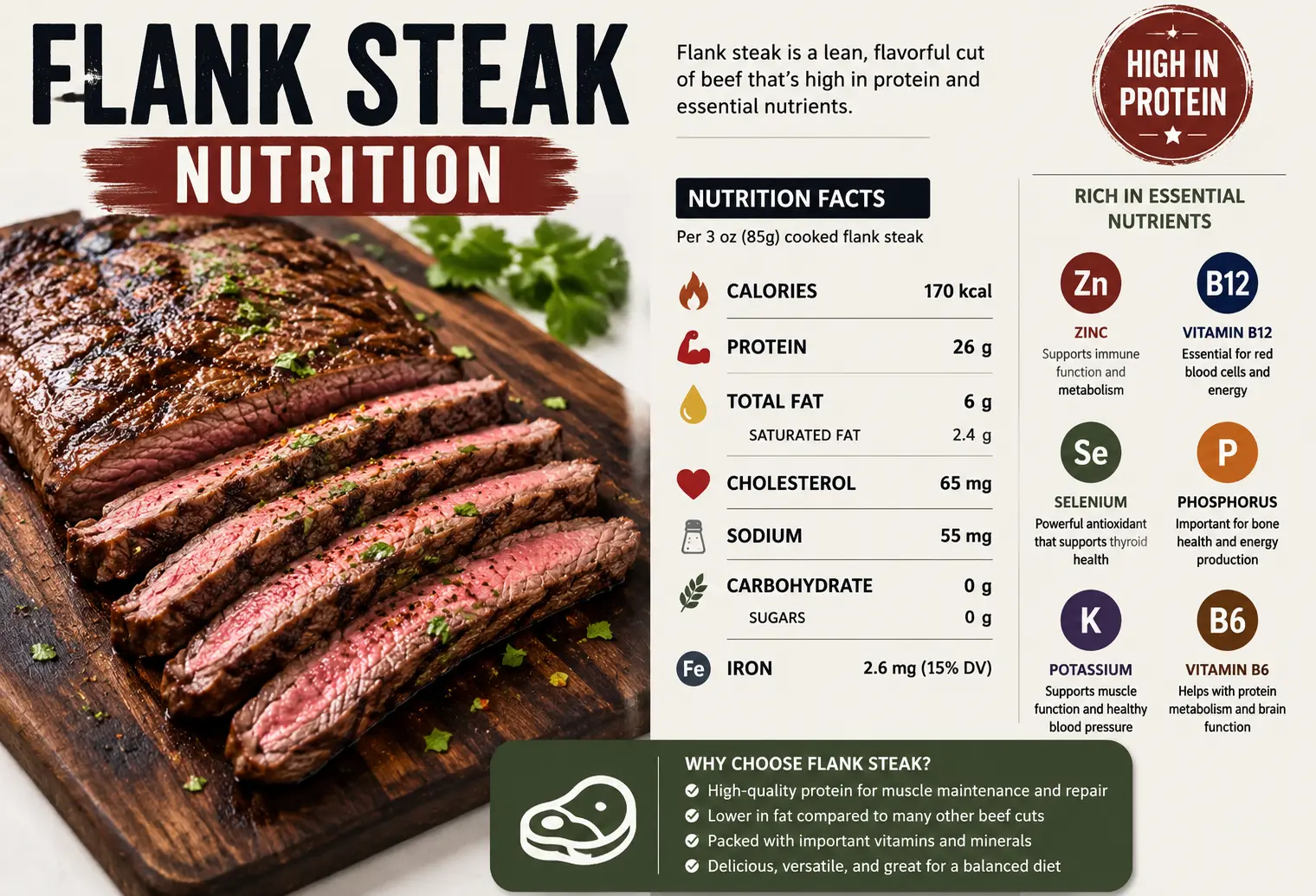
A 3.5 oz cooked portion of choice-grade flank, trimmed and broiled, carries 194 calories and about twenty-eight grams of protein. Fat sits near eight grams, with three and a half of that saturated. Carbs are zero. The same portion delivers useful iron, zinc, selenium and vitamin B-12.
Those numbers come from USDA’s nutrient data set for retail beef cuts, published in 2013, which puts trimmed broiled choice flank at 194 calories per 3.5 oz. Select grade runs leaner. Neither the grade stamp nor the cooking method is a rounding error, and both move the total.
| Nutrient | Per 3.5 oz cooked | Per 3 oz cooked |
|---|---|---|
| Calories | 194 | 165 |
| Protein (grams) | 28 | 24 |
| Total fat (grams) | 8 | 7 |
| Saturated fat (grams) | 3.5 | 2.9 |
| Carbohydrate (grams) | 0 | 0 |
| Cholesterol (mg) | 80 | 68 |
| Sodium (mg) | 56 | 48 |
| Iron (mg) | 1.8 | 1.5 |
| Zinc (mg) | 5.1 | 4.3 |
| Selenium (mcg) | 31 | 26 |
| Vitamin B-12 (mcg) | 1.7 | 1.4 |
Key takeaways
- A 3.5 oz cooked portion of trimmed choice flank runs 194 calories, with zero carbs.
- Broiled flank keeps about 81% of its raw weight, so 1 lb raw lands near 13 oz cooked.
- Log cooked weight. Entering the raw figure for a portion you already ate undercounts by close to a fifth.
- Grade shifts calories more than trimming does, with select about 16 calories per 3.5 oz below choice.
- Per calorie, top sirloin edges out flank on protein, and flank edges out inside skirt.
- One tablespoon of oil left on the meat adds roughly 120 calories to the whole steak.
Raw weight versus cooked weight
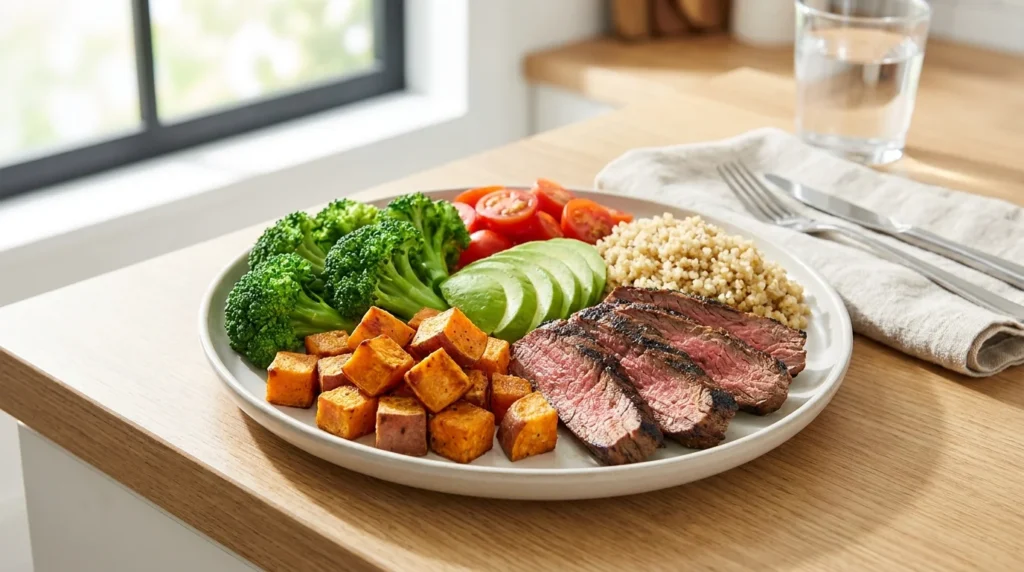
Meat shrinks. Water leaves, some fat renders, and the slab on your board weighs less than the one you carried home. For this cut the shift is big enough to change your numbers.
USDA’s table of cooking yields for meat and poultry reports that broiled or grilled flank finishes at 81% of its raw weight, across twenty samples. Put plainly, 1 lb of raw flank gives you close to 13 oz on the plate.
Calories barely leave with the drippings. USDA’s fat-loss figure for broiled flank is around 1%, so the steak holds nearly the same total energy after cooking as before. What changes is density. Raw choice flank measures 165 calories per 3.5 oz, while the cooked version of that same weight measures 202.
So the tracking error is predictable. Enter a cooked portion as raw, and you shave roughly a fifth off the true figure. Across a week of steak dinners, that is most of a meal.
What a 3.5 oz cooked portion really is
Start with 4.3 oz of raw meat, and you land at 3.5 oz once it comes off the heat. Picture a deck of cards and a half, sliced thin across the grain. Restaurant portions run much bigger than that.
Buying gets easier once you divide by 0.81. Want 6 oz on every plate? Buy about 7.5 oz of raw flank per person. A 2 lb steak, the common supermarket size, yields close to 26 oz cooked, which feeds four with a starch alongside. If that starch is a baked potato, it helps to know how potatoes stack up nutritionally before you build the plate.
Run the math at a shelf price of $12 a pound, and one 3.5 oz cooked portion costs about $3.25.
- 3.5 oz cooked, from about 4.3 oz raw, 194 calories
- 4 oz cooked, from about 5 oz raw, 222 calories
- 6 oz cooked, from about 7.5 oz raw, 333 calories
- 8 oz cooked, from about 10 oz raw, 443 calories
Trimmed, untrimmed, and the grade on the label
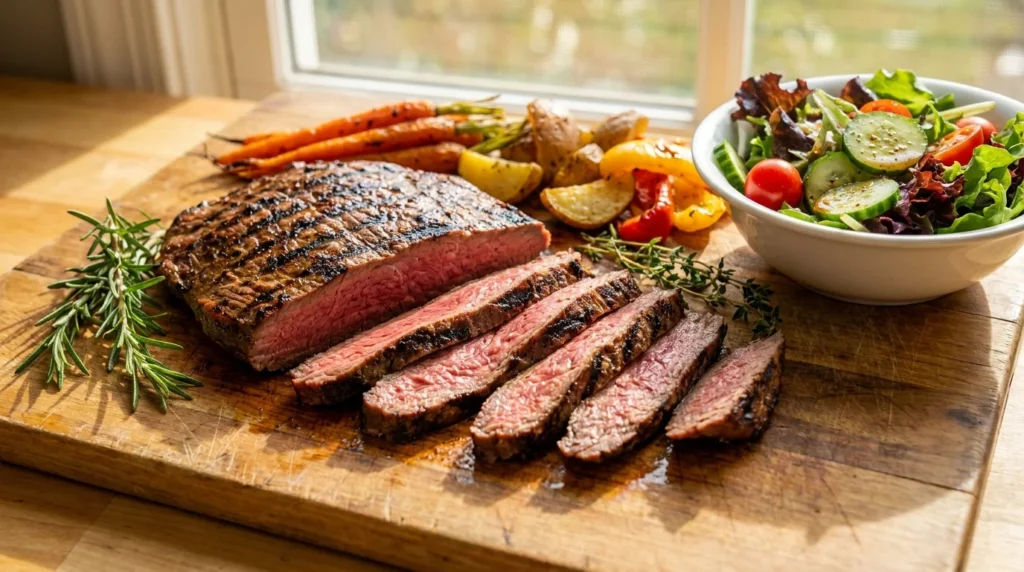
Flank carries little external fat, so trimming changes less than shoppers expect. The grade does more work. Choice has more marbling than select, and marbling shows up as calories.
| Version, 3.5 oz cooked | Calories | Total fat (grams) |
|---|---|---|
| Choice, lean and fat | 202 | 9 |
| Choice, lean only | 194 | 8 |
| Select, lean and fat | 183 | 7 |
| Select, lean only | 178 | 6 |
How marinade and oil change the numbers
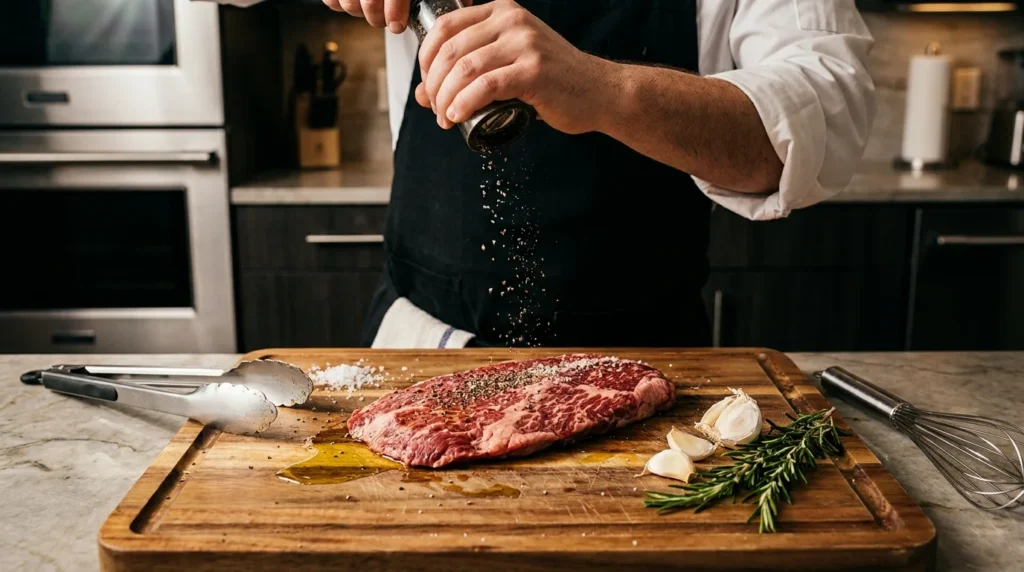
Flank is the classic marinade cut, and no nutrition table accounts for that.
Oil is the part that counts against you. Retention is not printed on any label, so the figures below are estimates rather than lab values.
- One tablespoon of olive oil holds about 120 calories. Brush it straight on and the meat keeps nearly all of it.
- In a bowl marinade, assume the meat retains roughly a fifth of the oil. A quarter cup of oil in the dish leaves close to 100 calories on a 2 lb steak.
- Soy sauce and teriyaki push sodium hard. Trimmed flank carries only 56 mg of sodium per 3.5 oz cooked, so the marinade becomes the main source.
- Sweet glazes bring carbs to a cut that has none. Two tablespoons of teriyaki land near 30 calories.
- Grilling over a rack lets rendered fat drip away. Searing in a pan keeps that fat on the meat.
Flank steak versus skirt, flat iron and top sirloin
All four are lean, quick-cooking cuts from working muscle. They are not identical on paper.
| Cut, 3.5 oz cooked and trimmed | Calories | Protein (grams) | Protein per 100 calories (grams) |
|---|---|---|---|
| Top sirloin, broiled | 187 | 30 | 16.0 |
| Flank, broiled | 194 | 28 | 14.4 |
| Flat iron, grilled | 202 | 28 | 14.0 |
| Inside skirt, broiled | 205 | 27 | 13.0 |
Top sirloin wins on protein per calorie. Flank sits second, ahead of flat iron and inside skirt, though the spread is small enough that price and flavor should decide most dinners.
Outside skirt is the exception worth watching. It carries far more fat than inside skirt, landing closer to a ribeye than to flank, so check which skirt the butcher handed you.
How much protein you actually need from it
A 6 oz cooked portion brings close to fifty grams of protein. For most adults, that covers a full day’s Daily Value in one sitting, which is why this cut works so well as the anchor of a single large meal.
Training changes the target. Lifters tend to spread protein across three or four meals instead of stacking it into one. Pair that habit with work that matches your goal, from heavy compound lifting to lower ab workouts for women. Steak alone will not get you there.
Putting the numbers on your plate
Flank steak nutrition gets simple once the weights are straight. Pick your cooked portion, divide by 0.81 to know what to buy, and count the oil in the pan. Do that, and everything else on the label falls into line.
Frequently asked questions
Cooked and trimmed, a choice-grade portion holds 194 calories. Select grade drops to roughly 178. Raw, that same weight measures 165, which is exactly why cooked weight is the honest number to log.
Yes, under the federal labeling rule for lean beef. A lean cut must stay below ten grams of total fat per 3.5 oz, and trimmed flank sits at eight. That puts it well under ribeye and near top sirloin.
Weigh it raw if you are portioning before it hits the grill, then convert. Weigh it cooked if you are logging what you ate. Mixing the two is the most common tracking mistake with this cut.
Only through oil and sugar. An acid and herb marinade adds almost nothing. An oily one can add 100 calories or more across a whole steak, and a sweet glaze brings carbs to meat that otherwise has none.
Slightly. Trimmed flank gives a little more protein per calorie than inside skirt, and a lot more than outside skirt. The gap is narrow, so your cooking method and portion size will shape your day far more than the cut does.